Translate

Showing posts with label migration. Show all posts

Monday, March 18, 2013

Doctors Without Borders (MSF) Exiting Morocco In Protest of Anti-Migrant Violence

Here is a piece from Reuters AlertNet on the notable and significant pull out of Doctors without Borders from Morocco in protest of the violence being met by African migrants in Morocco.
____

MSF reports rise in anti-migrant violence in Morocco

By Katie Nguyen

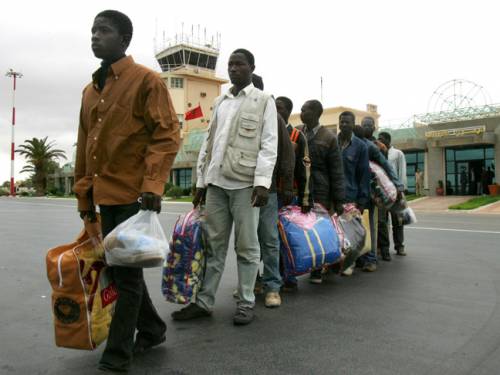
LONDON (AlertNet) - Migrants from sub-Saharan Africa have been subjected to increasing abuse, degrading treatment and violence by Moroccan and Spanish security forces since the end of 2011, Medecins Sans Frontieres (MSF) has said.

In the last year alone, MSF teams in Morocco’s eastern areas of Nador and Oujda, which border Algeria and the Spanish territory of Medilla, have treated the physical wounds of more than 1,100 migrants.

"Since April last year, in particular, we have seen broken arms, legs, hands and jaws, as well as broken teeth and concussions, amongst others," David Cantero, MSF head of mission in Morocco, said in a statement.

"These injuries are consistent with migrants' accounts of having been attacked by the security forces," he added.

In a new report, "Violence, Vulnerability and Migration: Trapped at the Gates of Europe", MSF said the European Union has over the past decade tightened its border controls and increasingly delegated responsibility for policing illegal immigration to countries that border it.

Since December 2011, there has been a "dramatic rise" in police raids on migrant communities in Morocco, MSF said, with reports of pregnant women, children, refugees and asylum seekers arrested and dumped in the no-man's land separating Morocco and Algeria.

And it’s not just security forces that are attacking migrants. MSF also blamed criminal gangs, bandits, smugglers and traffickers for widespread attacks against migrants.

Classified as "illegal" in Morocco, the predominantly West African migrants are offered little or no protection by the Moroccan state and so are attacked with impunity, MSF said.

"MSF's experience shows that the longer that sub-Saharan migrants are in Morocco, the more vulnerable they become," the report said.

FULL ARTICLE


Monday, June 18, 2012

Migrant Tensions in Morocco : Morocco as a Refuge for other Africans

Here is an article that originally appeared in Le Soir in French but was translated into English and made available on World News Australia.  It seems that migrants from other parts of Africa are counting on the notorious Moroccan trait of  hospitality .
___________


By Saad A. Tazi

LE SOIR/Worldcrunch

RABAT- Tensions are growing between Moroccans and immigrants from the rest of Africa. In May, Abdelhadi Khayrat, a Member of Parliament, described immigrants as “Libyan-trained terrorists conspiring to unhinge Morocco.”
From local populations who are quick to throw stones to elected representatives who overstep their prerogatives, the question of immigration is something that needs to be addressed. In the cities of Taourirt, Casablanca and Rabat, local authorities recently organized wide scale raids, arresting hundreds of illegal sub-Saharan immigrants.
Stuck between a Europe that feels besieged by immigrants and the African continent where people would risk almost anything for a chance at a better life, Morocco is changing before our eyes. For immigrants, it used to be a stopover on the way to Europe, but it is slowly becoming a new El Dorado in itself. Unfortunately, the country’s legal and social framework hasn’t adapted to this new context.

Illegal expulsions
Stephane Julinet, in charge of legal issues at the GADEM (Anti-racist Group for Accompaniment and Defense of Foreigners and Migrants), believes the recent raids against sub-Saharan immigrants were against the law. Article 23 states that “foreigners who have been notified of their expulsion have 48 hours to ask for an annulment by the president of the administrative court.” Given the fact that these arrests aren’t made on a case-by-case basis and that “it is the prosecutor who decides to expel foreigners despite the law requiring an administrative decision,” there is clear disregard for the legal process, says Julinet.

Article 29 specifies that a foreigner being expelled must be sent back to his country of citizenship, unless he has been granted refugee status or an asylum request is pending. Despite the clear options determined by the law, all illegal immigrants are currently being parked by the Algerian border – a border which is officially closed since 1994 – without taking into account their country of origin, how they entered Morocco -- and without the help of a translator or lawyer.
This makes the whole process, from beginning to end, illegal. Given the highly sensitive context, following the law should guarantee that the rights and dignity of all the people involved are respected. For Julinet, “Morocco must apply its own laws and stop treating the immigration issue as a mere security problem. It is time for Morocco to implement a real policy for integration.”


Saturday, October 9, 2010

9 Moroccan Stowaways Found in Shipping Container in Montreal Are Seeking Refugee Status


This is quite a story. It is just a relief that they survived the journey, Alhamdulilah. Here is the article from the CBC.
__________________________________________________

Stowaways arrested in Montreal speak out

Last Updated: Friday, October 8, 2010 | 8:05 PM ET
The Canadian Press

The stowaways were found hiding in a ship that docked at the Port of Montreal.The stowaways were found hiding in a ship that docked at the Port of Montreal. (CBC)A group of Moroccan nationals spent seven days hiding inside a cold shipping container, being ferried by a cargo vessel to an unknown destination.

And by the time they emerged from their dark, dank hiding place, they were surprised to learn they were approaching Canada.

Those scant details emerged as testimony at Immigration and Refugee Board hearings Friday, a day after Canadian authorities raided a ship and arrested the men inside.

"I got on a boat, I didn't even know where it was going," one young man explained through an Arab-French interpreter. "I thought the ship was going to Spain or Italy."

Most of the nine people nabbed at the Port of Montreal immediately applied for refugee status; they were all ordered detained while customs officials tried to confirm their identities.

While such hearings before the Immigration and Refugee Board are normally held behind closed doors, a commissioner hearing the cases accepted a request from journalists to report the details on the condition that they not name the claimants.

Seven of stowaways appeared before the board Friday.

Stowaways suffered harrowing ordeal, lawyer says

Among those who testified were two young men who explained that they spent nearly a week hidden in a shipping container aboard the Swiss-owned MSC Lugano.

They had no official papers with them. They said they snuck onto the ship and didn't receive any help from anyone. They insisted they had no idea where they were going.

They said they simply assumed they'd be headed somewhere in Europe when they boarded in Casablanca, Morocco.

Canadian border officials learned, in interviews with the men, that the group had spent about four days hatching their plan before hopping aboard the cargo ship.

The men initially claimed to be of Iraqi descent and gave fake names before later admitting they were from Morocco.

One young stowaway was using asthma medication Friday to offset the effects of the stale air in the container. The only other possessions with him were a cellphone and keys to a motorcycle. He told IRB officials he hadn't slept in seven nights when they first questioned him.

The baby-faced young man confessed that he'd once spent eight months in jail. He said he wanted to leave his country for a better life elsewhere.

"My goal was to work to help my family," he said in his brief remarks Friday.

Montreal lawyer Jamal Fraygui, who represented two of the men, said his clients had been through a harrowing ordeal. He called their initial contact with Canadian authorities a "terrifying welcome" as the men were questioned in the most "inhuman" conditions, on the ship at 3 a.m.

"My client is collaborating with authorities and he's prepared to furnish documents to prove his identity," Fraygui said. "You can see from the evidence presented … that it was not really a structured ring, it was residents of a neighbourhood that decided to take the risk."

Two others who have not claimed refugee status will have detention review hearings on Tuesday in Montreal.

Canada tries to shake reputation as choice landing for stowaways


Refugee hearings could take some time. IRB spokesman Robert Gervais said that, under the refugee-claims process, the men's case might only be heard in several months "or maybe a year from now."

The group's arrest made headlines Thursday. Such cases are generating particular interest as the Harper government promises a legislative crackdown on immigration queue-jumping.

Canada once held a reputation as a leading destination for illegal stowaways but the country doesn't routinely appear on lists anymore from the International Maritime Shipping Organization.

The organization says Italy is now the hot destination for illegal migrants seeking an easy port of entry.

Montreal and Halifax were regular destinations for Romanian migrants in the late 1990s.
© The Canadian Press, 2010

Friday, October 1, 2010

Deteriorating Situation for Sub-Saharan Migrants in Morocco


Here is a piece from the Doctors without Borders (Medecins Sans Frontieres) website about the work they have been doing to help migrants abused by Moroccan authorities in recent raids.

_______________
MSF raises concern over the medical condition of migrants after mass expulsions by the Moroccan police

© MSF

“Our team has witnessed the direct impact of these mass raids and expulsions on the medical condition and mental health of the migrants,” said Jorge Martin, MSF’s head of mission in Morocco.

Morocco - Médecins Sans Frontières (MSF) is deeply concerned about the deterioration of the medical and humanitarian situation of sub-Saharan migrants in Morocco after the intensification of raids and mass expulsions carried out recently by Moroccan police forces. Hundreds of migrants, including women and children, were deported to the no-man’s-land at the border between Morocco and Algeria and abandoned there during the night without food and water.

Police operations took place between August 19 and September 10 in cities throughout Morocco including Oujda, Al-Hoceima, Nador, Tangiers, Rabat, Casablanca and Fez. In many of the raids, police forces used bulldozers – and in Nador used helicopters – and destroyed migrants’ tents and houses.

An estimated 600 to 700 migrants were arrested during the raids and taken to the border between Morocco and Algeria. There, migrants were left to fend for themselves, without food or water. Among them were pregnant women, women with children and people with medical problems or with injuries directly or indirectly related to the police raids. They faced the choice of returning to Oujda on foot or trying to cross to the Algerian side of the border. Abandoned there in the middle of the night, they were at risk of being attacked and robbed by the bandits and smugglers who operate in the area. Those who have managed to reach the city of Oujda are completely destitute, without money, shelter or personal belongings.

“Our team has witnessed the direct impact of these mass raids and expulsions on the medical condition and mental health of the migrants,” said Jorge Martin, MSF’s head of mission in Morocco. “We provided medical support to a woman who had given birth to her child just six days before. She was arrested by the police forces and spent five days in a police cell with her newborn child. Then she was taken back to the border. She has managed to come back to Oujda, but is now suffering from acute gastrointestinal syndrome.”

During the past few weeks, MSF teams have seen an alarming increase in patients with medical problems related to incidents of violence. Of the 186 patients who have received medical care from MSF, 103 had lesions and injuries directly or indirectly linked to the violence during the arrests. The harsh living conditions and the lack of proper shelter have also contributed to the increase in medical problems. Almost half of the migrants who sought medical care from MSF teams had medical symptoms linked to the difficult and insanitary conditions in which they are living. Eighteen percent had skin infections, ten percent had respiratory infections and 11 percent had digestive problems.

“This intensification of restrictive measures to control migration in Morocco has a direct impact on the health and the dignity of migrants and refugees,” says Jorge Martin. Mass raids and expulsions to the border increase their vulnerability and put them at greater risk. MSF calls on the Moroccan authorities to adhere to their obligations under national and international law when implementing measures to control migration. The authorities must respect the dignity and integrity of migrants and avoid exposing them to a situation of greater vulnerability and insecurity. As stipulated in Moroccan law, pregnant women, children and other vulnerable groups of migrants must not be expelled to the border.

MSF has been working in Morocco since 2000, carrying out healthcare projects in Tangiers, Casablanca, Rabat and Oujda, providing sub-Saharan migrants with medical and humanitarian assistance and advocating for better access to healthcare and respect for migrants’ human dignity. Currently, MSF is running a project in Oujda providing medical and psychological care to migrants and refugees.

Saturday, May 1, 2010

Moroccans Struggle to Make Italy Home


Here is an article from the Financial Times about Moroccans living in Italy and the challenges they face.

_____________________________________

Moroccans struggle to make Italy home


By Guy Dinmore in Turin

Published: April 28 2010 18:33 | Last updated: April 28 2010 22:12

Change comes slowly in Italy and just as the industrial city of Turin is establishing itself as the country’s most progressive urban administration tackling integration issues, the tide of immigration may be starting to recede.

Evidence is anecdotal for the moment, but it appears that at least among the Moroccan community – the largest group of non-European Union immigrants, numbering some 30,000 in Turin – people are packing their bags and going home.

The economic crisis is biting and jobs are much harder to find. On top of that, new legislation makes it harder for immigrants to renew their residence permits, and the xenophobic Northern League, a hardline coalition ally in the centre-right government, is resurgent following its sweeping gains in regional elections last month.

Abdelaziz Khounati, the Moroccan president of an Islamic association that has the green light to build a mosque in Turin, reels off a list of cities where the Northern League has blocked similar projects, sometimes threatening to walk pigs across the land to desecrate it.

“First the League campaigned against the southern Italians who migrated to Turin decades ago, then it was foreigners in general. Now it is Muslims,” he says, standing in the large empty building, part of which used to be a Chinese-run clothing workshop, where the new Misericordioso (Merciful) mosque is taking shape.

It will be only Italy’s second formally recognised mosque after Rome’s, funded by the Moroccan government. For the moment Muslims across Italy worship in “cultural centres”, sometimes no more than a garage or a basement.

“We stand for an open, integrated, multicultural society where all people’s rights are respected,” he says. An Islamic cultural centre will be opened next to the mosque, promoting studies, social initiatives and inter-faith dialogue.

“The mosque has been a war of nerves,” says Ilda Curti, city councillor for integration under Sergio Chiamparino, Turin’s popular leftwing mayor, as she describes how the Northern League has tried but ultimately failed to exploit legal loopholes to block the city-backed project.

Turin, described by the United Nations as a best practice model in Italy, has focused on integration in schools and runs a scheme giving immigrant youths the chance to work as volunteer social workers, bending the rules to ensure they keep their residency.

But Ms Curti says difficulties in obtaining Italian citizenship are also driving away young and talented immigrants who have come through school but now face insurmountable barriers. The “medieval corporativism” of many professional associations makes citizenship a condition of membership.

The Northern League’s victory at the polls last month – where it defeated the centre-left administration in Turin’s surrounding region of Piemonte – is further bad news for immigrants. The League intends to strip non-Italians of their access to unemployment benefits, a feature unique to Piemonte, even though some have been paying their taxes for years.

Mohammad Mouharba was among the first wave of migrants in 1989, when Italy offered jobs and residence permits. Mr Mouharba now runs a popular bakery specialising in Arab and Italian pastries on the edge of Porta Palazzo, Europe’s largest open-air market where many fruit and vegetable stalls are run by Moroccans.

People he has known for years are going home, unable to renew their residence permits. “They expel you if you have no work. This is inhumane,” he says. “With the League it will get worse.”

His two children, aged 18 and 15, have Italian citizenship and are “more Italian than Moroccan”, he says. “But you always remain an immigrant here.”

Copyright The Financial Times Limited 2010.

Saturday, April 17, 2010

Trying to Make it into Melilla


Until we can find some more uplifting news out of Al-Maghreb, here is article from the Guardian about people trying to use the Moroccan territory of Melilla that was colonized by Spain to get their "big break" into Europe.
__________________________


Melilla: Europe's dirty secret

African migrants will do anything to get into the Spanish enclave of Melilla. And the authorities will do anything to keep them out

Back in the autumn of 1998, a teacher from Melilla called Jose Palazon noticed something strange was happening each night to the dustbin in front of his house. He kept an eye out and discovered that, under cover of darkness, a young boy was removing the rubbish from the bin so that he could sleep in it. The idea of the child being reduced to the status of trash was worrying but not entirely surprising to Palazon, who was used to the sight of migrants sleeping rough on the streets of his city.

Melilla sits on the north coast of Africa, surrounded by the waters and territory of Morocco. For the ceaseless tide of African and Asian migrants working their way northwards, it has a compulsive attraction: by accident of military conquest more than 500 years ago, this city which is geographically African is legally part of Spain. As the migrants reach the Mediterranean, where so many of their predecessors have died, Melilla offers them a safe bridge into Europe – if they can smuggle themselves across its barricaded perimeter.

Palazon and his wife, Maite, got talking to the boy and found he was only 11 years old and had been living in the dark corners of the city since he had come over the fence from Morocco three years earlier. They succeeded in adopting him and tried to persuade the city's council to help the other migrant children on its streets, joining with friends to form a campaigning group called Prodein. But, Palazon recalls: "They didn't want to help the children, as that would encourage more to come to Melilla."

And that is the problem behind the simplistic calls for British jobs for British workers – if you treat migrants well, give them the kind of human rights Europeans demand for themselves, you only encourage them to keep coming. So Melilla has become a kind of theatre, acting out the most intense human dramas which are calculated to send a message of deterrence to that great global audience of hopeful poor.

The message is: "Don't be fooled by the wide avenues and beautiful fountains of this Spanish city. None of this is for you. Stay where you are, stay poor and, if you dare to try to come here, we'll hurt you. If you're really unlucky, we'll let you stay here and you'll have no way out, you'll just be trapped and hopeless, without any legal rights to call your own."

This theatre clearly involves the Spanish, although they have shown some signs of attempting to be humane, but it is by no means uniquely their production. The Moroccans, too, are deeply implicated in the killing of migrants on the African side of the fence as well as in the entirely illegal export of men, women and children into the desert beyond their borders. And the European Union as a body is the power behind the Spanish, funding the production, writing the script, ignoring the casualties, whether physical or legal. To protect our jobs, the EU authorises Melilla to be a theatre of cruelty.

When Palazon found the boy in his bin, in the late 90s, this could be pretty crude. The Council of Europe's committee for the prevention of torture uncovered evidence that Africans who made it into Melilla were held in farm buildings where conditions were so bad, some took refuge in abandoned cars on a nearby rubbish dump. They were then likely to be given by the police a drink of water containing a tranquilliser, after which they could be wrapped in adhesive tape covering almost all of their body, including their mouth, for easy delivery by military plane to their country of origin where, in some cases, reports emerged of them being ill-treated and even killed by local law officers.

In those days, the 10km fence around the landward side of the city was not much more than rolls of barbed wire. In 1999, as EU resistance to migration grew, the city erected an intimidating new barrier – two parallel 4m wire fences, topped with razor wire and with a tarmac strip running between patrolled by the Spanish Guardia Civil, all of it monitored by 106 video cameras, infrared surveillance, a microphone cable and helicopters. In Melilla, a man who had worked on the fence told me he would arrive at work in the morning to find his ladder covered in blood, where migrants had tried to use it to climb into the city and had become victims of the razor wire.

Some made it over the fence. Some managed to smuggle themselves into the city in the backs of cars. Human Rights Watch found that children travelling alone were still finding their way in and were being held by the Spanish in an old fort, La Purisima, where they were beaten by staff, robbed and assaulted by older children, and kept in punishment cells for up to a week without bedding or toilets before being shoved back into Morocco where the police might give them another beating and put them out on to the streets to fend for themselves. Human Rights Watch concluded that the Spanish were breaking their own immigration laws and were guilty of "arbitrary and discriminatory" behaviour. (You begin to see why Jose Palazon's dustbin seemed attractive.)

Still, the new fence worked – not by stopping the migrants but by diverting many of them out to sea. They emerged from the Sahara and embarked for the Canaries or southern Spain in tiny rowing boats, sometimes succeeding, sometimes drowning – until 2004, when the EU paid for extra coastal patrols and sent them flowing back to Melilla and to a new and bloody crisis.

The migrants gathered in their hundreds in the scraps of woodland outside Melilla and organised mass assaults on the city's perimeter. By summer 2005, Amnesty was reporting that those who were caught on the fence were being treated with excessive force by Moroccan and Spanish guards, and those caught inside the fence were being illegally expelled back into Morocco, often to be dumped in the desert. By autumn, there was clear evidence of murder at Melilla and, along the coast, outside the similarly Spanish city of Ceuta.

A human rights lawyer from Melilla, Jose Alonso, went out to the fence at night: "It was the closest I have ever been to a war, going to the fence and seeing what was happening. There was a helicopter over the Spanish side with a huge light shining down on the Moroccan side. There was shooting. From where I was, I saw hundreds of people trying to get over the fence. Both sides were shooting down at them. It was like a film about a war."

Between August and October, there were at least 11 deaths at Melilla and Ceuta – most of them shot with live ammunition as they rushed the fence at night; one man with his throat crushed by a rubber bullet; dozens of others injured by bullets or by falling from the fence; many of them reporting they were assaulted and robbed by security forces. The Spanish said it was the Moroccans; the Moroccans said it was the Spanish. On one night during these months, six men were shot on the Moroccan side of the fence at Melilla: the Moroccan authorities said this was self-defence because the migrants were throwing rocks at them. Nobody was charged with any of the killings.

In the background, Amnesty tracked Moroccan security forces sweeping through the makeshift camps in the woodland, rounding up migrants, including asylum seekers, and dumping them out in the desert on the Algerian border, 30km from the nearest village, without food or water. Some tried to walk into Algeria, only to be caught by Algerian forces and sent back to Morocco. Médecins Sans Frontières found 500 migrants, including pregnant women, stranded in two villages in the area and reported that in the previous two years, they had treated nearly 10,000 migrants with illnesses and that nearly a quarter of them showed clear signs of violent attack, including beatings, shootings, attacks with dogs and sexual assaults, all of which the victims attributed to security forces. The Moroccans blamed the Algerians. The Algerians blamed the Moroccans.

Looking back at these few months of intense violence, Amnesty concluded in a special report: "In the past few weeks, scores of people have been injured and at least 11 killed while trying to cross into the Spanish enclaves of Ceuta and Melilla when they were confronted by the law enforcement officials of both countries… Hundreds more, including possible asylum seekers, have been rounded up by the Moroccan authorities and placed in detention or forcibly removed. The evidence we saw showed law enforcement officials used force which is both unlawful and disproportionate, including lethal weapons. They injured and killed people trying to cross the fence. Many of those seriously injured inside Spanish territory were pushed back through fence doors without any legal formality or medical assistance." The Spanish reacted by building an even bigger fence, subsidised by the EU.

By the time they had finished, the landward side of Melilla was protected by three 6m parallel fences, decorated with motion sensors, cameras and watchtowers, prowled by cars and helicopters and more troops than ever. The migrants kept coming. The guards kept shooting. On one night in July 2006, three African men were killed at the fence and 12 others injured. More started coming round the seaward side of the city, sometimes in small boats or even on jet skis, sometimes paddling in life jackets, sometimes face down and no longer breathing.

The Spanish and their paymasters in the EU reacted by creating a new kind of fence, a bureaucratic one. Migrants trickle into the city. Some apply for asylum, some simply ask for the right to reside. Their cases are considered and almost always rejected. Some of the rejects can then be expelled. But many come from countries that have no repatriation agreement with Spain. For years, the Spanish dealt with this by giving them a letter telling them they were expelled and putting them on the ferry to mainland Spain with instructions to take themselves back home, knowing that they would disappear into the world of black-market jobs and phoney papers. But as word of their success spread homewards, more followed. Now, they are not allowed on to the ferry; and they cannot be sent home because their countries have no agreement with Spain; they cannot be shoved back into Morocco because there is no agreement with it either; and so they stay, a living warning to those who might be tempted to follow.

There are hundreds of these stranded people in Melilla. Many are Asians who have paid people-smugglers to get them to Europe. In Melilla, I met them and heard stories of terrifying journeys, which began well enough, with the smugglers flying them from the Indian subcontinent through Dubai into central Africa, often into Mali, and then disintegrated as the smugglers betrayed them.

Shaibul was 23 when he left Comilla in south-east Bangladesh in January 2004, clutching his degree in commerce, aiming for Madrid and the chance to earn money to send back home. He was stranded in Mali for six days, alone in a house while the smugglers disappeared; he was stranded again with 17 other Asians somewhere in the Sahara when their driver vanished; then picked up and dumped in a date field in Algeria, where a gardener betrayed them to police, who drove them out to a scorching wasteland back on the border with Mali and left them.

"We found people in tents there," Shaibul told me. "They were lost, too. They called this place Zero. We begged food and water. One person in our group had a mobile phone and we spoke to our families. We were crying, very afraid. It was stone cold at night, baking in the day. There were high winds and sandstorms. Our families went to the smugglers, who said they must pay more money. My father said, 'I cannot lose my son', so he borrowed more from the bank and gave it to the smugglers. Other families did the same."

Moved by this extra money, the smugglers came and drove them back into Mali and, as the weeks went by, extorted two more payments from the families of their passengers while they drove them north and south, abandoning and rescuing them, until finally, having sold the family's land in Bangladesh, Shaibul's father secured him a place on a speedboat that took him from the coast of Algeria to the bottom of a cliff. "They told me, 'This is Spain, you must wait for the sun and then go up the cliff.'" Of course, it was not mainland Spain – it was Melilla. It was 29 December 2005 when Shaibul reached the top of the cliff and walked into the city. It had taken him 23 months to get there. And now, more than four years later, he is still there.

He can't move on to mainland Spain because the Spanish will not let him, although it is not clear that they have any legal right to restrain his movements in this way. He has not been charged, convicted or jailed for any crime. He is stranded. He cannot get back into Morocco or Algeria, because they will not take him. He cannot go back to Bangladesh, because they have no repatriation agreement with Spain, and anyway, Shaibul says: "My family have lost everything to pay for me to be here. Better to kill us than to make us go back."

He and several hundred other migrants survive in Melilla, partly because the Spanish authorities have provided a new Centro de Estancia Temporal de Immigrantes, known as the Ceti, where there are clean, safe dormitories and regular meals; partly because people hire them for odd jobs, washing their cars and sweeping their paths. They constantly ask Ceti staff for news of their permission to stay, but are told that it is for the police or the government to decide. If they become agitated, they are given tranquillisers. They say the only way to get a place on a ferry to the mainland is to act as a police informer. They refuse. From time to time, police make raids on the Ceti to grab migrants for expulsion. Many prefer to sleep on the streets than take the risk.

Moroccan soldier Hicham Bouchti applied for asylum in Spain after accusing the Moroccan authorities of running a regime of torture in their prisons. He has spent more than four years bouncing between borders, always coming back to rest in the nowhere land of Melilla. The last I heard of him, he was deep into a hunger strike.

Then there were the young parents of a baby boy. The mother was Moroccan, the father Indian. While the mother had been ordered back home – where she feared punishment from police and family for having sex before marriage with a non-Muslim – the boyfriend was told that he could not go with her because the Moroccan authorities would not accept him. Instead, three years after arriving in the city, he must continue to wait.

Ali Achet, who used to work in a CD shop in Dakha, has been stuck in the city since 9 December 2005. His family paid €3,000 (£2,626) to a smuggler, who agreed to fly him direct to Morocco. Instead, he was sent by bus to India, then by plane to Ethiopia and Togo, where he lived as a beggar for a year and was reduced to a walking skeleton, before finally his family helped him to bribe his way into Melilla in the back of a car. He said, "We came looking for liberty, but this is a prison. What have we done? Every day we wait for a solution. We are suffering. We have nothing now. A prison sentence is definite. This is endless."

Gregorio Escobar, governor of Melilla, sits in his well-appointed office in his neat grey suit. "We have a responsibility to take care of this border," he says, "not only for our own citizens but for all of Europe. Also, Spain has a responsibility to take care of the people who happen to get inside." He is no monster, and explains that he understands the pull of the city when the average per capita income inside Melilla is 15 times higher than it is on the other side of the fence in Morocco, and almost immeasurably higher than in sub-Saharan Africa, from where most of the migrants come.

Not far from Escobar's office, a group of about 50 Asians gather in the Plaza Menendez y Pelayo and chant a call for their human rights. Amnesty has continued to record reports of migrants being beaten and shot and dumped in the desert by the Moroccans. In Britain, the jobs are safe for British workers.

• Additional research by Jill Baron

Tuesday, July 28, 2009

Abuse of Moroccan Migrant Farm Workers in Italy


Here is short article from the Wall Street Journal about some Moroccan migrant farm workers in Italy who were being taken advantage of, but it looks like they might actually be treated like worthwhile human beings by officials in Italy. Alhamdulilah

______________________________________________

Moroccan Migrants In Italy Found In Poor Work Environment


GENEVA (AFP)--About 1,000 Moroccan migrants have been found working and living in squalid conditions on farms in southern Italy after being lured there, the International Organisation for Migration said Tuesday.

Many of the irregular migrants traveled from Morocco after they were promised seasonal contracts and wages that never materalised, according to IOM officials.

Instead they were paid just 15 to 25 euros a day, and even had to pay a three-euro fee to gain access to the fields where they were supposed to work, and also pay for water.

"Their living and working conditions are unsafe, insalubrious and undignified," said the IOM representative in Italy, Peter Schatzer.

An IOM spokesman criticised the prevalence of illicit migrant labour in Italy.

"According to official statistics, the informal sector represents nearly 18% of GDP so we're calling on our partners, at national, local and regional level to clean things up with employers," said spokesman Jean- Philippe Chauzy.

The IOM was called in by Italian authorities, which had established a quota system for employers that need seasonal workers.

"Our team discovered that most of the migrants have fallen victim to a fraud," said Schatzer.

"They paid a fee to a rogue agent in their country of origin and to an Italian employer, who promised to give them a regular job," he said.

"Once in Italy, the migrants found that their employer had disappeared or just refused to employ them. Without a legal work permit, many fell into exploitation."

The conditions were revealed after some 200 of the Moroccans were interviewed by the Geneva-based agency. They are likely to receive local assistance, or the chance to return to Morocco, said Chauzy.

Saturday, July 25, 2009

North Africa Seems Very Close


Here is an article from the New York Times about the French city of Marseille, and the Maghrebi (North African) cultural influence over the city.
___________________________________

Marseille Sways to a Maghreb Rhythm

By SETH SHERWOOD
Published: July 26, 2009

AS a warm Saturday night hung over the Mediterranean, the Algerian-French band Yazmen shuffled under the spotlights with its instruments — hand drum, flute, electric bass and a boxy, long-necked stringed instrument called a guembri — while a crowd filed into the hot confines of the windowless Tankono club.


Couples arrived with children while bespectacled record-store geeks and a bald guy in a dashiki made toasts with Kronenbourg beers. Close to the stage, a dozen or so French bohemian types in their 30s pressed together in their best thrift-store finery.

“We’re going to start with some traditional gnawa, but a bit more modern,” the lead singer, Nabil Acef, said in French. “Are you familiar with gnawa?”

Anywhere else, the question would very likely be met with pin-drop silence. But not in Marseille.

“O-o-o-o-u-u-u-i-i-i-i-i-i-i-i-i-i!” came the explosive reply, as the musicians, all smiles, began a rollicking, jazz-fusion take on gnawa, a centuries-old music heard throughout North and West Africa.

Because of Marseille’s geographical proximity to North Africa and France’s colonial history there, which ended only in the 1960s, Marseille may be more deeply linked to Morocco, Tunisia and Algeria than any non-African city. Some 120,000 to 150,000 people from those three countries — known collectively as the Maghreb — live in Marseille, a bustling and slightly raffish port city of around 800,000.

And so, a palpable North African wind seems to blow through this city’s sun-baked hills, where the orange tile roofs of aging 19th- and 20th-century town houses rise and fall like the waves of the adjacent Mediterranean Sea.

Tea rooms, Moroccan restaurants, Tunisian pastry shops and hallal fast-food joints dot the wide boulevards and small passages. Hammams and hookah cafes echo with Arabic and Kabyle, the language of Algeria’s Berbers.

“You can feel like you’re somewhere in Algiers, or you can feel like you’re somewhere in Casablanca,” said Zéphora Nachite, an Algerian-born festival organizer, as she sipped mint tea at Fantasia, a cafe popular with the city’s North African crowd.

“You hear raï in the streets,” she said of Algerian pop music. “Couscous is practically the national dish of France, and especially Marseille.”

To celebrate Marseille’s deep connection with the people of the Maghreb and other ethnicities, Ms. Nachite in 2008 started the Fête de la Mediterranée, an outdoor festival of songs, crafts and food. Held again this past May, the festival is just one of the recent developments — bands, boutiques, hotels, spas — that are raising the cultural profile of North Africans in Marseille and helping to the city into a veritable Sahara on the sea.

Which is not to say that Marseille is without big-city problems. The unemployment rate is 50 percent above the national average, and the city is troubled by a lingering reputation for crime. As the French newsweekly Le Point observed in a 2007 feature about Marseille, “In the collective imagination of French people, the name is associated with the Mafia, truants and thieves.”

Still, as the same article noted, France’s second-largest city actually ranked seventh in crime that year. More tellingly, Marseille was spared the kind of violence that rocked some of Paris’s immigrant-heavy suburbs in 2005.

For Nora Preziosi, who was born in Marseille to Algerian immigrants and is a senior aide to the mayor, the key to the city’s harmony is in its integrated street life.

“It’s not like Paris, where you have the banlieues to the north or south,” said Ms. Preziosi, referring to the public housing districts in suburban Paris. Geographically segregated from central Paris, those generic and dilapidated minicities have historically absorbed many of Paris’s poorest immigrants and their descendants.

“Here,” Ms. Preziosi continued, “we have just one community, Marseille. Whether we’re North African, Armenian, Jewish, whatever, we consider ourselves Marseillais first.”

The city’s unofficial anthem could easily be “Sous le Ciel de Marseille” (“Under the Sky of Marseille”), by a young Algerian-born pop star, Kenza Farah. Sung in both French and Arabic, the song is a tender homage to the city’s bouillabaisse of cultures:

Marseille you are like a mother to me

You welcome me with open arms

Marseille, mix of colors

Consoles all who have suffered.

Any journey into Marseille’s Maghreb side should — must — begin at the Marché de Noailles, by the Noailles metro stop. The daily fruit-and-vegetable market is the whirling epicenter of the city’s most venerable and colorful North African neighborhood, which sits symbolically in the very heart of Marseille’s downtown.

There on a Tuesday morning in late May, women in traditional robes and headscarves were snapping up oranges, melons and green beans from Morocco. “Yalla! Yalla!” — “Let’s go! Let’s go!” — one vendor ordered an assistant in Arabic, after he was slow in bagging some vegetables for a customer.

Afterward, shoppers peeled off down the Rue Longue des Capucins, where every free inch seemed to be plastered with concert posters promoting an upcoming festival of “Musique Souk” and a “Soirée Orientale Avec Chaibi et Malouf.” A few blocks away, along the tiny Rue de l’Académie, women in caftans ambled into the Hammam Rafik, while men in fezzes and skullcaps removed their shoes and packed into an Islamic prayer room across the street.

At lunchtime, crowds converge on the Rue du Musée, home to one of Marseille’s most celebrated restaurants, Le Fémina. Opened in 1912 by a young man from a rural Algeria town, it is now run by his great-great-grandson, Mustapha Kachetel.

“We do home cooking using recipes that have passed from father to son and mother to daughter,” said Mr. Kachetel as a largely French lunch crowd began to file into the rustic stone-walled space. In the kitchen, women in matching striped shirts stirred steaming cauldrons and diced vegetables. “My sisters,” he said with a smile.

The restaurant’s reputation is built on its prowess with one simple dish: couscous made from barley semolina. In contrast to the yellow wheat semolina commonly found in Morocco and France, the barley variant has bigger and rougher granules, a darker color and earthier flavor.

The restaurant imports its barley semolina from Algeria, steams it to fluffiness, then tops it with a medley of slow-cooked meats: merguez sausages made from Charolais beef; brochettes of marbled lamb from Sisteron in Provence; roast chicken; and a breast bone of lamb that has been stewed in vegetable broth to make the thin layer of meat exceptionally tender.

With its venerable French clientele — which has included Gérard Depardieu and many French politicians — Le Fémina might be the city’s most enduring cultural crossover. But it’s getting plenty of company these days. Especially in the worlds of design and hospitality, young North African artists and entrepreneurs are leaving their mark on the city and updating Old World traditions for a modern European audience.

Consider Ryme Alaoui, whose grandfather was a mosaic-maker in Fez, the old Moroccan city famous for its artisans. Today, Ms. Alaoui, 36, runs Art et Sud, a showroom that sells mosaics made by artisans back in her ancestral city.

Side tables, dining tables, decorative wall panels and entire floors all glow with kaleidoscopic, intricate geometry. Any piece can be designed to order. None would look out of place in a London loft.

At Les Bains du Harem, the most classic of North African institutions — the hammam — has been transformed into a chic full-service spa that has drawn everyone from the French pop star Amel Bent (who has North African roots) to Sting.

On a May afternoon, a European-looking man in his 30s relaxed in a eucalyptus-scented steam room lined in earth-tone mosaics, after a lathery massage in jasmine soap and an exfoliation with African karité (or shea) butter and sea salt. Just outside, a French couple luxuriated on sultanic cushions and nibbled honey-pistachio pastries in the ornately sculptured relaxation room.

Sitting in the tea salon, the owner, Sandrine Aboukrat, who was born in Marseille, explained that the concept for Les Bains du Harem was inspired by girlhood outings with her Moroccan-Jewish grandmother. “Every Friday afternoon, she would come by our house, pick up me and my mom, and take us to the local hammam,” Ms. Aboukrat said.

But perhaps no one in Marseille is doing more to combine the North African and the modern than Fatiha Ouichou. Born in Morocco and raised in Paris, Ms. Ouichou, a former marketing and branding executive, made her first splash in Marseille with Le Ryad. The nine-room boutique hotel, which she opened in central Marseille in 2005, imagines a Marrakesh-style guesthouse inside a classic French town house.

Last year, Ms. Ouichou took her cross-pollination of Moroccan and Western styles a step further with a boutique, Inspiration Ryad. An airy space with white walls, high ceilings and a vast picture window, this shop feels more like an art gallery. But the goods displayed on the long white shelves — ceramic vases shaped like conical tagine cookers, leather cellphone holders sporting the Islamic hand of Fatima symbol, minimalist-chic caftans with Arabesque swirls — suggest a shelter magazine redesign of a Moroccan bazaar.

“I’m trying to raise the image of Moroccan crafts, which most people associate with the low-quality things you find in the souks,” Ms. Ouichou said.

As the third weekend in May rolled around, the two ends of the North African musical spectrum — one resolutely conventional, one energetically contemporary — flared to life in a pair of performances around Marseille. Taken together, they formed yet another testament to the diverse creativity that has emerged from the Marseille melting pot.

For the traditionalists, the weekend’s marquee attraction was at the Espace Julien, a long music hall with a tiered floor, sophisticated lighting and large stage. One night, a well-heeled middle-age crowd — many French, many clearly with North African blood — filled the seats as the Orchestre Tarab took the stage in matching black outfits. Formed by Algerian immigrants in the late 1990s while a vicious civil war tore apart their native country, the small orchestra broke into the exotic scales and polyrhythms of Old World Arabo-Andalusian music, one of Islam’s most revered genres.

Soon, they were joined by a special guest. Like the others on stage, Alain Chekroun is a native Algerian who relocated to southern France, but one telling article of clothing set him apart: a yarmulke. Mr. Chekroun is an Algerian Jew. When the spotlight fell on him at last, Mr. Chekroun closed his eyes and sang liturgical songs drawn from the Torah and his Jewish faith in a high, clear voice that was by turns mournful and joyous, as his Muslim countrymen provided the soundtrack.

FOR the younger generation, the top action unfolded back at Tankono, where Yazmen continued to blaze through a set melding the soulful vocal harmonies of gnawa through a succession of radio-friendly Western musical styles. Cosmic funk jam sessions gave way to desert blues before merging into jazzy bossa nova-like passages. Voices dropped in and out, intersecting across the melodies.

Soon, the music shifted again to a breakneck belly-dance rhythm. Girls shimmied and twirled. Guys raised their Kronenbourgs and clapped to the beat.

When the show finally finished, the musicians hopped off stage to join their fans outside the club in the Rue des Trois Mages. Earnest and thoughtful, Malik Ziad, the group’s curly-haired guitar and guembri virtuoso, explained that Yazmen’s distinctive music derives partly from its members’ different nationalities: four of them were born in Algeria; one is native French. All met in the interethnic swirl of Marseille.

And while Mr. Ziad confessed to missing his hometown of Algiers — another hot and lively Mediterranean port city filled with old French buildings and squares — he said that Marseille has proved to be a welcoming substitute.

“I see my homeland here,” he said, as the last of the crowd filed outside, the warm night air filtering into the windowless room. “The same architecture, the same climate, the same sun, even the same mindset.”

“You know, we have 48 official provinces back in Algeria,” he added. “Around Marseille, everyone likes to say that Marseille is the 49th. And it’s true.”

Thursday, July 23, 2009

Dutch Photographer Joins a Moroccan on an Illegal Boat Ride into Europe


This article from a paper in the Netherlands is a bit of a twist on the usual Moroccans-on-boats-sneaking-into-Spain story just because no one dies in it, Thank God. It would be great to be able to see the photos of the journey that are now on display in the Hague. But is this kind of documentation trivializing a dangerous act done out of the woe and desperation of poverty and oppression?

________________________________________

Dutch photographer travelled as boat refugee

Published: 22 July 2009 17:17 | Changed: 22 July 2009 17:36
By Rosan Hollak

Joël van Houdt followed a Moroccan who made the journey to Europe as an illegal immigrant. The photographer did not want to think too much about the dangers of the boat trip.

A young man in a white T-shirt wearing a white cowboy hat on his head and a smile on his face stands on a pedestrian crossing. Behind him palm trees wave in the breeze, expensive cars are parked along the roadside.

Nothing in this picture, taken by Dutch photographer Joël van Houdt in October 2008, betrays the difficult path this apparently cheerful boy had to take in order to walk in the Spanish sun.

Every step of the journey

But the other photographs in the exposition Entering Europe in the Gemeentemuseum in The Hague give a different impression. The man, Mohamed, is a 26-year-old illegal immigrant from Morocco. He was photographed during every step of his journey to Europe; hanging around aimlessly with his friends in a café in southern Morocco, in a small boat during a hazardous crossing, and scrambling up the coast of La Graciosa, a small Canary Island near Lanzarote. “Upon arrival we were immediately arrested,” Van Houdt (1981) told, as he walked through the exposition area recently.

“Mohamed was flown back to Morocco. But since he had ripped up his identity card and refused to tell the Moroccan authorities where he came from, he was once again put on a plane to Fuerteventura. That is where he was released after 30 days in prison. That is when I took that photo at the pedestrian crossing," Van Houdt said

Van Houdt followed Mohamed’s life for more than a year. In 2007 he flew to Casablanca for the first time. “I did not come across Mohamed until after some time. When we sat watching a football match in his home town one evening I told him about my plan to do a project on boat refugees. He said he had been toying with the idea of going to Europe for years. That same evening we started looking for a contact person.”

Boat broke in two

Finding a human trafficker proved reasonably simple. But Van Houdt did not realise that he would be dealing with characters who would take their money, but not follow through on their agreements. “We made three attempts. The second time that we went on board a boat at night, it broke in two just off the coast.”

Van Houdt knew he was running a great risk by travelling along. The rickety boats in which illegal immigrants make the crossing are anything but safe. "I felt the journey was a mandatory part of the project. That blue sea is also a beautiful metaphor: it is a boundary of water surrounding Fort Europa.”

He consciously did not stop to think about the risks he was taking. “I never checked the boats, I didn’t want to think about that, I might have started to have doubts then.”

He simply felt that he had to tell this story. “I wanted to give a boy like Mohamed a face. I hope this project helps people better understand what someone like this goes through. The media often talks about illegal immigrants in such a simplistic manner. As if they are all fortune hunters who want to go to Europe to earn money. But it isn’t that simple," Houdt said. "Mohamed left because as the eldest son in a family of nine children, he was expected to achieve something. His parents invested in him, he studied law, but there is no work in the village where he comes from. He simply could not get anywhere, so he had to leave. But he would much prefer to be able to stay with his family.”

Material confiscated

On 28 September 2008 Van Houdt and Mohamed set out to sea on a boat for the third time. “There were 28 of us there on the boat for 36 hours. We were supposed to go to Lanzarote but the captain let us off on La Graciosa.” Upon arrival Van Houdt was also arrested. He was released that same evening but his material was confiscated. “That was very stressful. I had seven memory cards with several thousand photographs.”

He then had to appear before the judge in Lanzarote, without a lawyer. “At that time I demanded my material be returned. The judge did not like that. But I thought: this is Spain, I am a journalist, what can happen to me? It was four months before I got everything back.”

In the meantime Mohamed has ended up in northern Spain. "I visited him last week. He had been at the Red Cross for four months, after that he was homeless for three weeks. Now he is in a building run by the social housing authority, with nine other illegal immigrants. He told me that one night he just couldn't take it and thought about going home. He called a friend, who told him: where you are now, that is my dream, you must stay."

Friday, May 22, 2009

French People of Moroccan Ancestry "Returning" To Morocco and Nigerian Immigrants Trying to Leave


Here are two different articles dealing with movement in,out, and around Morocco. One, from the Wall Street Journal, presents the case of French citizens of Moroccan background who have better job prospects in Morocco than they do in France and the other, from This Day Online, is about Nigerian immigrants who are sometimes held against their will in Morocco as a part of human smuggling operations and who hope to return to Nigeria.

______________________________________________


* MAY 22, 2009

In France, Immigrant Offspring Return to Ancestral Homelands


By SEBASTIAN MOFFETT

PARIS -- Nawal El Kahlaoui grew up near Paris as the daughter of a mechanic who left Morocco to seek a better life in France. But after finishing her university studies here, Ms. Kahlaoui moved back to Morocco to find work.

"I love Morocco, as the country gave me a chance," says the 35-year-old retail consultant in Casablanca. "It's a land of opportunity."

A growing number of well-educated French people of immigrant backgrounds are returning to their parents' homelands. There are no official figures on the number of "returnees," and government officials, scholars and employment agencies say the number is small. Still, this gradual U-turn reflects a relative decline in the desirability of life in parts of Europe, compared with some developing countries.


Mass immigration to France started in the 1960s, as the economy grew strongly, creating jobs. In addition to migrants from southern Europe, workers came from France's former colonies, in particular Algeria, Morocco and Tunisia.

As France's economy slowed in subsequent decades, however, unemployment rose, and hasn't dipped below 7% for the past quarter of a century. In recent years, the jobless rate for immigrants has been around twice that of non-immigrants. Now that France is in recession, the first jobs to go are often those filled by minorities.

Most of the French "returnees" are of Moroccan background, according to people who have studied the phenomenon, though there is also a trickle to other former French colonies, such as Algeria and Vietnam. In 2002, Rabat set up a "Ministry for the Overseas Moroccan Community," to encourage émigrés to return and invest their skills in their native land.

Morocco is also becoming more open and prosperous. Overhauls under King Mohammad VI, who ascended to the throne in 1999, have improved freedom of expression and women's rights. In addition, the country has formed free-trade agreements with the U.S. and the European Union. The economy expanded at an average of more than 4% from 2000 to 2008, and even this year is expected to post growth higher than that. While a large number of rural poor keep Morocco relatively low in international measures of economic prosperity, city life can be good for better-off residents.

Life can be better than in France. Surveys show that in France, applicants for a job have around a third the chance of getting a reply if their name sounds Arab or African as they do with a more traditional French name.

But no one knows the exact extent of inequality: The French Republic's doctrine that everyone is equal has so far ruled out the collection of statistics on race and religion. As a result, unlike in the U.S., there are no detailed data on how many French people are black, Arab or Asian -- and how they fare in education and work.

Opponents say that such an ethnic census would divide society by validating the existence of groups based on race and religion.

President Nicolas Sarkozy, acknowledging the problem, said before his 2007 election that he wanted better ways to measure discrimination, and in December he appointed a commissioner for diversity. Algerian-born Yazid Sabeg recently published a report in which he recommended that people be allowed to identify -- but not in a mandatory way -- which ethnic group they belong to on official documents.

"We need to measure the negative situation that is the result of different appearances," Mr. Sabeg said in a recent interview in his office on Paris's Left Bank. "It's very important for France to get out of its fantasy that there is no discrimination."

A French education is highly valued in former colonies, and salaries are good relative to the cost of living.

In Morocco, former émigrés are very welcome. Big European companies have been actively recruiting French-educated staff for their units there over the past three or four years, says Jamal Belahrach, president of the North African operations of job agency Manpower. The recruits find they can rise faster in their careers than they would have in France -- and are surprised to find a country different from the one their parents left. "There's a generation who didn't see Morocco in the past, and now sees the modern Morocco," he says.

Barka Biye's parents had moved to France from Morocco when she was just two months old. Ms. Biye graduated in law from the University of Paris, and then worked for several years in insurance. In 2007, she decided to look for a job in Morocco. She found one with a French insurance company in Casablanca in just two weeks.

"I thought I could play my part in the evolution of a country going through big changes," she says. "Morocco is expanding fast, and the companies who set up there want managers educated in Europe and at the same time capable of understanding the country's culture."

When Ms. El Kahlaoui was job-hunting in the late 1990s, she had trouble finding an interesting job, even though she held an undergraduate degree in chemistry from the University of Paris and another in marketing from ESSEC, an elite business school.

When she asked a university careers adviser why she was having so much trouble, the woman gave her some advice: "She told me I had to change my name and address," says Ms. El Kahlaoui. The problem: Her name and address told potential employers she was from a typical North African immigrant background.

In Casablanca, Ms. El Kahlaoui started off working for French pharmaceuticals company Pierre Fabre and then German cosmetics group Beiersdorf before joining a small retail consultancy.

She says she's happy in Morocco, but being there makes her feel very French. "I will come back ," she says, "but only when the system can generally accept people like me.


______________________________
______________________________

Morocco: Sordid Lifestyles of Nigerian Illegal Immigrants

05.21.2009


Chinwe Ochu who was in Rabat, Morocco recently tells the sordid life of Nigerian illegal immigrants in that country which revolves around drugs, rape, begging, tribal gangsterism, murder and other criminal activities. She also encountered one of the Nigerians who wants to go back home

Her spoken English is good. She would not strike you as someone who would abandon her studies in the university for an illegal stay abroad. I met Joy Peters, a 22 year-old secondary school graduate from Ememuri, Edo State at the Nigerian Embassy in Rabat, Morocco. She had given herself up for repatriation to Nigeria after her dreadful stay in Morocco.

Through a friend, she had met a man named 'Baba London' in Benin City, “who promised to take her to Spain to help his wife out in her boutique business.” According to her, the recklessness of the whole arrangement was that she did not know Baba London from Adam and did not ask the necessary questions; neither did she pay him any fees for the travel.

“My father is late and I normally help my mother in the farm. I am the last in the family. So I wanted to put one or two things together so that I can provide more money for us.” Two days after the meeting, she set off with him; in addition to two other girls from Edo State on the journey. “I did not know him. I didn't ask him any questions. He never told me that we were going to Morocco.”

She described to THISDAY the horrendous journey: to Morocco: “I left Nigeria on February 3, 2009. When we (ten of us) were going, we passed through the desert with a Maburro jeep. On our way, we met other people in Algeria and then we got to Morocco and stopped. We got to Morocco in April. It was a long journey. We took the desert road from Issalha to Wahkla to Oran to Algeria, because we faced deportation to Tisawhati. So, we spent almost three months on the road.”
When I asked what sustained them on the journey, she said: “He bought some food items; we were eating Geisha, bread and some juice on the way. We were three girls form Benin that Baba London took. I don't know where all the girls are right now because I was locked up immediately we got to Rabat, Morocco.

“I told him that this was not the Europe that we agreed upon and he said that I should not worry that from Morocco, we will pass through the sea to Europe. I became scared and told him that my mother was not aware of me leaving the house. I now told him that I am going back to Nigeria and he insisted that I should stay there and later I will be in Europe. I said no because I have heard stories that people used to die in the sea. That got me scared.”

Joy continued: “When he wanted to go back to Nigeria he handed me over to his friend, an Edo man named Ason, who was maltreating me. He said that he had spent six years in Morocco. That first night, he was nice. Then everything changed. I later found out that he does not have a work. He begs for a living. A lot of young Nigerian men beg for alms in Morocco to feed. He smokes Hashish and marijuana and comes back very drunk. He raped me all night and will invite his friends too. He said that he attended Ambrose Ali University, Ekpoma and that he was an Eye cultist. That if I scream, he will cut me in pieces. When I refuse, he will beat me mercilessly and say that I do not respect his friends. He ties me up every time he goes out, hands and feet with shoe laces. It was really painful. When he comes back from his begging, he will bring the little food stuff he brought and I will cook just like his wife.”

Joy alleged that she made several attempts to escape Ason's grip, but she was not successful. “Once, I ran away and met an Igbo man who said that he does not want to get involved with these boys because they are dangerous; and he returned me to him.”
All indications pointed to the fact that she was sold to the said Ason as a sex slave. It was then Ason's responsibility to make contacts with other 'buyers' from Spain, who will in turn pay so much money for Joy. Just like the slave trade. Joy would overhear some men bargaining prices for her. She escaped when Ason forgot to lock the door one day and ran to an Ivorian woman in the neighbourhood, who equally begs for a living. She accommodated her until she was strong enough to go to the Nigerian Embassy.

According to her, at the Embassy, she is not even safe since the Ason has friends everywhere and would inform him of her whereabouts. “He will wait for me at the corner till he gets me. I have made him loose some money because no one has bought me already.”

Commenting on the present state of affairs, Mrs. Amina Garba, a Councillor at the Nigerian Embassy in Rabat, Morocco said the situation of Nigerian illegal immigrants in Morocco is really shameful and pathetic. She said the number of Nigerian citizens in the country is not definite due to the high incidence of unregistered arrivals. Garba said most of them are wanted people back in Nigeria. According to her, they are mostly felons who escaped the law from their various states in Nigeria and traveled through the desert road to North Africa.

“The unemployed Nigerians here beg for alms to feed themselves. They go to public places like the mosques, supermarkets carrying their babies and wearing tattered clothes. It's a difficult situation for us here. Most of them come here and continue with their various nefarious activities. They are hardened criminals. They normally demand what they call “passage money” from new Nigerian settlers into their neighbourhood. Failure to provide such fees often results in bloodshed.”

Another situation has reared its ugly head amongst the illegal Nigerian immigrants' community in Morocco-tribalism. Garba explained that “these Nigerians in Morocco have “houses,” according to tribes. Each tribe has a chairman that coordinates the group. Sometimes they have tribal wars amongst themselves that result in violence and bloodshed. Each and every house has own mafia and perpetuates violence. Recently, an Esan man killed an Igbo man over a dispute of 20 dirams (Moroccan currency).

“He was subsequently arrested and sentenced to twenty years in prison. The Igbos, instead of leaving the matter as it is, started their revenge scheme by kidnapping all Edo people that they could lay their hands on, raping, maiming and killing them.
“Reports have it that in Ouchda (a border town between Morocco and Algeria); there is an Igbo man called the 'National Lord'. He arranges for the kidnap of a large number of female illegal immigrants whom he locks up in rooms. While being raped, these women are videotaped and the videos sent to their relatives in Europe demanding ransom for their release. He is said to be rich and bribes his way out of prosecution,” Garba told THISDAY.

When asked what the Embassy is doing about this 'National Lord' and other nefarious Nigerians, Garba said “When the embassy sought more information on the said 'National Lord', nobody wanted anything to do with the investigation. Nobody wanted to reveal anything.”

The Councillor said that the Consular issue is the Embassy's most daunting challenge. She said that “if only the Nigerians can live peacefully amongst themselves . . . The Moroccan police sometimes say that they have let some Nigerians that are illegal immigrants go because they look poor and harassed. What they are bothered about is for them not to disrupt public peace.”
According to her, statistics have it that in the Casablanca prison, Nigerians are the second largest in number after the Moroccans- totaling over 100. Of this number, 60 are for drug-related offences, while the others are jailed for murder, maiming and violence of all sorts.

At the end of the day, Joy entreated to be taken back home to Nigeria, saying that she wanted to go back to school. “I wouldn't wish for what I went through for my enemy”, she said.

Is it not high time Nigerians stopped bringing shame to this great country and work for the common good of Nigeria? Although we might be lacking in basic infrastructure for a normal living, engaging in disgraceful conduct outside the shore of this country will contribute to the negative perception that pervades the average hardworking innocent Nigerian worldwide. Or are we not re- branding anymore?

Thursday, May 14, 2009

Has 40 Years of Migration Helped Morocco?


There are a lot of things in the news right now about economic deals Morocco is entering in regarding power plants, fishing, cell phones, etc and big resorts that are going to be built in the country. This article taken from Radio Netherlands website seems a bit more interesting, it is looking at how 40 years of out migration from Morocco has affected the country.

________________________________________

Has 40 years of migration helped Morocco?

By Philip Smet*

13-05-2009

Forty years ago saw the beginning of a stream of migration from Morocco to the Netherlands. The so-called "guest workers" wanted to earn money for their families at home. Today, around three million Moroccans live outside the country. In total they send more than three billion euros to the area they come from every year. Has it helped?

Fouad Haji from Rotterdam was born forty years ago in the Rif Mountains, the area along the Mediterranean coast from which many Moroccan men have left for Europe. They were later followed by their families. This is how Mr Haji, now a Rotterdam councillor, came to the Netherlands at the age of 13. He still visits his homeland regularly and is very critical about what migration has done for his country.
"In the first instance you would say migration has done a lot for the people of the Rif Mountains. You see beautiful, large newly-built houses. The people who stayed behind can depend on receiving financial support," says Mr Haji, who has just returned from a conference in Morocco, at which this very problem was discussed.

"But the disadvantage is that Rabat thinks that these people can look after themselves. The government leaves the region to fend for itself. All attention is focused on other regions in the country. That is annoying. If you look at the democratisation process, the level of education, depth of investment, industry and healthcare, then the Rif Mountains is still a deprived area. More than 60 percent of the money in Morocco is earned there, but it is not invested there. That annoys me."

History
In the year Mr Haji's was born, 1969, Morocco and the Netherlands reached an agreement on migration. Belgium, France, and Germany had already done so long before. The Moroccan government stimulated the migration of labour from the impoverished Rif Mountains to the wealthy European continent. Rabat hoped this would tame the rebellious region. As a result of the economic crisis in the 1970s, many of the Moroccan migrants did not return to the region. Many families followed the men. Today around three million Moroccans live outside the country, a large proportion of them born outside Morocco. In spite of the increasing integration there are substantial social problems surrounding the Moroccan community in these countries.

Investment
There are around a million Moroccans in France and roughly 380,000 in the Netherlands. There are also Moroccans in Spain, Germany, Italy, and in the Gulf States and North America nowadays as well. In total they send around 3.5 billion euros to their mother country via official channels every year, says Morocco researcher Paolo de Mas. Mr De Mas has been studying Morocco for more than 30 years and until recently was managing director of the Dutch Morocco Institute in Rabat. In addition another two billion euros come into the country in cash every year, he estimates.

Mr de Mas sees that the Rif Mountains has benefited little from the billions of euros that have come in from abroad. Banks may have opened branches in towns in the Rif Mountains, but they invest the money outside the region. Even migrant Moroccans do the same, says Mr de Mas:
"In the beginning they transfer money to their families, build them a new house in their village. That is always the first phase. Then they look to see whether they can do more to improve the standard of living. But once they have bought agricultural land and put in a few water wells, they invest their money in property such as hotels or apartments in the more prosperous parts of Morocco. The reality is that in the Rif Mountains for instance there is limited room for investment."

Lifestyle
It is clear that the money from abroad is an important economic factor for the whole of the country. But according to Mr de Mas, the family abroad also has a huge influence culturally and politically:
"When you look at lifestyle, the migrant regions have undergone a complete transformation in the last forty years. Morocco has been bombarded by external ideas, norms and values. For example on the age of marriage, on sex, but also on democracy, consumption levels, music. It is impossible to separate the increasing fundamentalism or conservatism from the enormous financial, moral and psychological influence from the West."

In Rotterdam, councillor Fouad Haji is glad that Western ideas on democracy are getting through to the Rif Mountains. He thinks it's up to the people who live there to do something about their situation. He is critical, but optimistic.
"People now understand that they can put pressure on the authorities via the media and politics and by organising themselves and taking to the streets. They couldn't do that before. And they understand that they can exert pressure by withholding the money that is sent to them. That you can use it to put the regime under pressure."

* rnw translation (nc)

Wednesday, April 8, 2009

"Leaving Tangier" by Tahar Ben Jelloun, A Book Review


Here is a book review, of Leaving Tangier by Tahar Ben Jelloun
that ran in the Washington Post. According to the review, the book seems to speak to all of the crazy desperation that is palpable amongst Moroccan youth.

____________________________

FICTION
Living Far From Home

By Dennis Drabelle
Washington Post Staff Writer
Wednesday, April 8, 2009; Page C04

LEAVING TANGIER

By Tahar Ben Jelloun

Translated from the French by Linda Coverdale

Penguin. 275 pp. Paperback, $15

At one point in this short but ambitious novel, a character philosophizes about those "on the margins of society," including "an American writer who'd lived [in Tangier] for several years with an illiterate Moroccan boy, while his wife had set up house with a peasant woman." There's irony in that allusion to expat novelists Paul and Jane Bowles, who came to Morocco to find themselves: The same dream impels many of the characters in "Leaving Tangier" to ditch Morocco for Spain.

The author himself, Tahar Ben Jelloun, moved from Fez to France in 1961. He seems to know the many ways in which people-smuggling can be done and, more important, how the uprooting affects those who submit to it and those who take them in. The story of Azel, Jelloun's main character, is fairly typical: He has a university degree but no way of parlaying it into a good job. Long praised by his mother as "the handsomest boy in Tangier," he decides to make good on that asset. After meeting Miguel, a rich older Spaniard who visits Morocco regularly, Azel becomes gay for pay, the pay being that Miguel will take care of the young man if he can find his way to Spain.

That he does, at first faring well enough as Miguel's paramour: The surrounding luxury is easy to get used to, and, in bed with Miguel, Azel closes his eyes and tries to conjure up women who have pleased him. But Miguel has repeatedly been double-crossed by previous lovers, and he punishes Azel prospectively by humiliating him in front of their friends. For his part, Azel comes to realize he has overestimated his ability to be who he's not.
ad_icon

As the novel heads toward a brutal climax (but not the one you might expect), Jelloun weaves in the stories of other emigrants: Azel's sister, who embarks on a joyous affair with a seemingly flawless young Turk, only to find out she's badly mistaken; a small-time Moroccan-Spanish gangster; a Cameroonian who draws upon world literature to comment on the action. The novel ends with a surrealistic paean to the combined pain and hope of sending oneself into exile. Artful and compassionate, "Leaving Tangier" evokes a milieu of self-exile and great expectations in relatively few pages.

Monday, November 3, 2008

Migrants Jumping Border Between Morocco and Spain

Spain: migrants try to jump fence to flee Morocco
The Associated Press
Published: November 2, 2008

MADRID, Spain: Spain's Interior Ministry says a dozen African migrants tried to jump a border fence that separates Morocco from the Spanish enclave of Melilla.
An official with the ministry office in Melilla says four migrants reached the enclave but were caught. Three border guards were slightly hurt Sunday during scuffles.
It was the fourth time this week African migrants tried to enter Spain illegally by scaling the fence that separates Melilla from Morocco.
The official spoke on condition of anonymity, in line with ministry rules.
Thousands of African migrants seeking a better life in Europe try to enter Spain each year. Most try to reach the Canary Islands by boat and others try enter Melilla or Ceuta, another Spanish enclave on Morocco's northern coast.

_________

Original article link is here