Translate

Showing posts with label art. Show all posts

Thursday, February 25, 2016

Moroccan Cultural Center to Open in Paris 2018

Here is an article from the Art Newspaper on the planned Moroccan Cultural Center that will open in Paris in 2018. Completely funded by the Moroccan government and unfortunately, to be built on land where there currently stands the historically important home of the anti-colonial Association des Etudiants Musulmans Nord-Africains (Association of Muslim North African Students) until the 1980s.
__________

France to get its first Moroccan Cultural Centre in 2018

 by Victoria Stapley-Brown  |  20 February 2016

The Royal government of Morocco will fund a €6.7m Moroccan Cultural Centre, due to open in Paris in late 2018, Le Monde reports. The plan was announced on Wednesday, 17 February at the Institut du Monde Arabe in Paris, in the presence of the King of Morocco Mohammed VI and the French president François Hollande.

The architect, Tarik Oualalou, has been working with the Paris mayor’s office and other government bureaus for two years on the project. 
 
Full Article

Friday, December 18, 2015

"Gradual Kingdom:" NYC Art Exhibit by Meriem Bennani

Here is a piece from the New York Times about an exhibition by Moroccan artist, Meriem Bennani at  Signal gallery entitled Gradual Kingdom.
___________

Credit: Dan McMahon

Meriem Bennani’s ‘Gradual Kingdom’ Focuses on Morocco

By MARTHA SCHWENDENER
DEC. 3, 2015

Meriem Bennani’s first show at Signal, “Gradual Kingdom,” might not be as funny as her other projects, which have appeared on sites like Instagram and included a reality show parody (now under actual development) about a hijab designer whose zany head scarves function as purses or Carmen Miranda-like apparatuses. Instead, this exhibition focuses on her hometown, Rabat, Morocco, and how it fits, sometimes depressingly, into global networks of commerce and real estate.

Near the gallery’s entrance are three rudimentary hologram machines — made out of televisions, glass panels and LEDs — displaying images of filtering sand, drifting rose petals and shattering glass. A narrow, floating staircase attached to one wall is coated with sand and leads nowhere. More sand is in the rear of the gallery, this time a pile with an elongated iPhone sculpture lying on it. Ms. Bennani’s home region has nearly been depleted of sand, which has been exported to build artificial islands in the Middle East and offset erosion at luxury beaches around the world. (The sand here comes from an industrial supplier across the street from the gallery.)

FULL ARTICLE

Tuesday, February 10, 2015

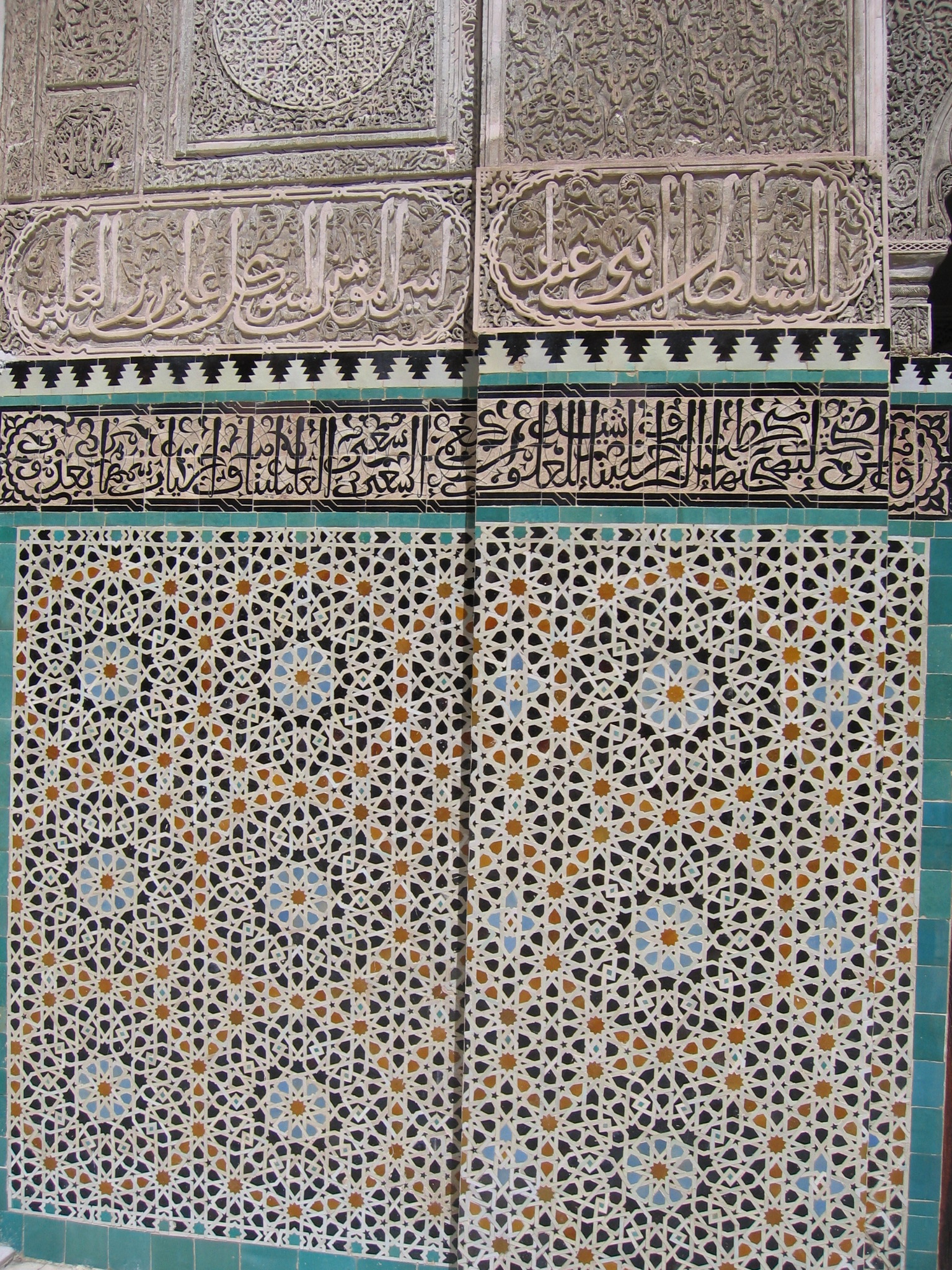
Islamic Geometric Design Heritage - Part of the Beauty of Morocco

Here is a piece from the Guardian on the geometric designs developed by Muslim artists/mathematicians and common in various forms throughout North Africa and the Middle East. These designs are part of  the beauty of Morocco. 
There is a step by step tutorial in the article if you're interested.

________________________________________
credit: Fabos, wikimedia commons

Muslim rule and compass: the magic of Islamic geometric design


To paraphrase Monty Python, what has Islam ever done for us? You know, apart from the algebra, the trigonometry, the optics, the astronomy and the many other scientific advances and inventions of the Islamic Golden Age.

Well, if you like art and interiors, there’s always the stunning patterns that grace mosques, madrasas and palaces around the world.

Islamic craftsmen and artists – who were prohibited from making representations of people in holy sites – developed an instantly recognizable aesthetic based on repeated geometrical shapes.

The mathematical elegance of these designs is that no matter how elaborate they are, they are always based on grids constructed using only a ruler and a pair of compasses.

Islamic design is based on Greek geometry, which teaches us that starting with very basic assumptions, we can build up a remarkable number of proofs about shapes. Islamic patterns provide a visual confirmation of the complexity that can be achieved with such simple tools.
Dust off your old geometry set, and let’s see how.

FULL ARTICLE