Moroccan graduates face bleak prospects | |||||||
|


Morocco has an unusual problem - the more educated you are, the harder it seems to be to get a job.
The overall unemployment rate is officially less than 10% - but the rate for graduates soars above this, and has sometimes been double.
Every day frustrated and highly educated young people gather outside parliament in the capital Rabat to shout out their frustration.
"I'm 35, I have a PhD in physics, and I can't get a job," complains Ali.
"I'm very old, I'm not married, I don't have my own house, I don't have anything.
"I'm thinking of leaving this country, because here I am nothing."
Entrepreneurs Sometimes the protestors are chased away by riot police wielding truncheons.
The government is worried about the problem, and has set up a number of schemes to help graduates to find work.
One of them, known as moukawalati, aims to give government-backed loans to budding young entrepreneurs.
There are success stories.
Merieme, a 25-year-old woman, is the owner of a printing business.
Several gleaming new machines hum in the background as she explains how the scheme helped her to develop her business plan and convinced the bank to lend her money.
But Merieme's experience is far from universal.
Initially the target was to help 30,000 business people, and create 90,000 jobs.
Yet so far only 1,400 loans have been given out, and the government has had to scale back its targets.
Mistakes
The head of the state body that runs the scheme, Kamal Hafid, admitted to the BBC mistakes had been made.
But he said one of the main problems - with consequences stretching far beyond moukawalati - is that Morocco's school system is out of sync with today's job market.
"The educational system must get better - that's obvious to everyone today," he said.
"But it will take time, there is a lot of work to be done.
"And we need to develop entrepreneurial spirit here in Morocco too."
Many of the unemployed graduates marching up and down outside parliament have turned down work in the private sector.
They want the security of a state job.
But as Mr Hafid points out, the state can only hope to create 15,000 new jobs a year, while in good times the private sector can produce up to 300,000.
Illegal migration
Nevertheless, the private sector often feels Moroccan graduates are poorly suited to the modern economy.
There are fears too about how the international financial crisis may affect Morocco.
All this is having serious effects.
"There is a concern about illegal migration among young people, and about drugs," says university professor Lahcen Haddad.
"There is also a very serious concern about a lot of people being easy prey for extremists."
In 2003 11 young men blew themselves up in the economic capital Casablanca, killing themselves and 34 others.
Moroccans were also among those who carried out the Madrid bombings, and hundreds have fought in Iraq.
Typically these people have less formal education than the graduates demonstrating outside parliament.
Double-edged sword
Roughly half of Moroccans are illiterate - a shocking state of affairs in a country that is one of the most developed in Africa.
Morocco has a demographic problem too. It is estimated that more than a quarter of a million young people will come onto the job market every year - and there is little chance all of them will find work.
"It is a double-edged sword," according to Mr Haddad.
"Either Morocco can tap into that, use it as an opportunity and then the Moroccan economy will take off, because you are using that human capital to be more productive.
"Or it can be socially very costly, because here you have all these people of working age, but many of them are unemployed, with all the social consequences this brings."
The government is certainly aware of the potential risks, and says it is doing all it can.
But the unemployed graduates protesting outside parliament see this as just one more empty promise.
"I'm a pessimist now," says Ali.
"Life in Morocco is very hard. There is no light here, no light." | |||||||
Thursday, February 26, 2009
Overeducated and Underemployed in Morocco


Tuesday, February 24, 2009
Moroccan Toads , Moroccan Tide - Environmentalists working in Morocco

I've come across these two rather interesting sites both dealing with an environmental matter in Morocco. One is concerned with studying an endangered toad and the other about the use of the clothing detergent Tide in Morocco and how this must be affecting the groundwater.
Below is a short portion of the Tide article, click on the link above for the full version :
_______________________________
On the 30th May 2008, almost 10 months ago, colleague and good friend of mine decided to write to Alan G. Lafley, Chairman of Procter & Gamble .
My friend had just returned from Morocco where he had been shocked by the overwhelming presence of Tide washing products in most of the rural areas he had visited. He shared one observation that is rather common place in the Maghreb: many inhabitants wash clothing directly in the streams of the back country.
With Tide washing powder available everywhere in nearby markets, the obvious question that sprung to his mind was whether the products had been adapted to the local environment. In fact, Moroccans use the word "Tide" in a generic manner to describe a "detergent". This is telling of the product's importance the country.
Morocco suffers from water scarcity and overall poor water quality. The Government has a very informative website that depicts a comprehensive portrait of the country's water resources (in French and Arabic) .
Yet, many Moroccans are using one of Procter & Gamble's leading brands: "Tide". They do so directly in the streams. An estimated 90 percent of wastewater in developing countries similar to Morocco is still discharged directly into rivers and streams without any waste treatment processing[1].
Many streams in Morocco show very little quantities of dissolved oxygen, especially when of industrial or agricultural origin. Authorities also report that water quality in many lakes, basins, and reservoirs show increasing signs of eutrophication . It is proven that this situation usually originates from inputs of nutrients such as nitrogen and phosphorus from human activities such as farming, washing, and industrial processes.
Sunday, February 22, 2009
Upcoming Fez Festival of Sufi Culture

From the French language Moroccan newspaper, Le Matin, an article about the upcoming 3rd annual Fez Festival on Sufi Culture
Below is a short summary in English provided by the folks at Sufi News and Sufism World Report .
__________________________________
3rd Fez Festival of Sufi Culture, on April 18th-April 25th 2009
"Sufism is a culture extremely present and rich in Morocco. Due to its diversity generating great emotion, it has always accompanied us in our traditions and customs, enabling a true perception of Islam", said Faouzi Skali, President of the Festival.
The theme of this third edition allows us to ask questions about the role of Sufism in the contemporary world, including:
"How to link spirituality with business, environmental, social action?"
"How spirituality and Sufism can become actors of human development?"
The festival will try to answer these questions by highlighting the artistic richness that Sufism inspires in painting, calligraphy, singing, music, films, books, exhibitions ...
| ||||||||||||||||||||||

Thursday, February 19, 2009
Tijani Zawiya in Fes and its Many West African Visitors
Moroccan shrine unites Africans
| By James Copnall BBC News, Fez |
 Muslims from across West Africa worship at the tomb of Sheikh Tijani |
The 12-centuries-old city of Fez is known as Morocco's spiritual capital, but it also has huge relevance for millions of West Africans.
They come in droves - from Senegal, Mali, Niger and Nigeria - to worship at the tomb of a North African holy man, Sheikh Ahmed Tijani.
Senegalese men in flowing twilight blue Boubous mingle with Moroccans in hooded Djellabas at the impressive gate of the Zaouia, or religious centre for the Tijani brotherhood, in the narrow and winding streets of Fez's old town.
Sheikh Tijani, who was born in Ain Madhi in what is now Algeria, is reputed to have learnt the Koran by heart by the age of seven, and given his first fatwa (religious instruction) at 15.
He founded the Sufi brotherhood at the end of the 18th Century - using the Gregorian calendar - or towards the start of the 13th Islamic century.
Muslims flocked to hear the teachings of the holy man, who had spent long periods meditating in the Sahara Desert.
The Moroccan sultan of the time, Moulay Slimane, supported Sheikh Tijani, aiding his rise.
All sorts
Tijani disciples from neighbouring countries spread the word and now there are millions of his followers in West Africa.
 Zoubir Tijani says the shrine attracts more than 12 nationalities |
"I have visited many African countries, and there are villages and towns where you don't expect to find even a sign of civilisation, but you find a Koranic school and other buildings put up by the Tijanis," says Zoubir Tijani, a descendent of Sheikh Tijani, who looks after his mausoleum.
"Secondly, our brotherhood sticks very closely to the Koran.
"Sheikh Tijani said if you hear me say something which contradicts what the prophet says, you must ignore it.
"This message appeals to people, so if you go into the Zaouia now you will find more than 12 nationalities.
"In this brotherhood you find all sorts - ordinary people and ministers."
The former Senegalese Prime Minister, Moustapha Niasse, comes from a famous Tijani family, and Hissen Habre, the former dictator of Chad, is a Tijani.
Zoubir Tijani brushed away suggestions that Mr Habre, who is accused of numerous human rights abuses, had clearly found it difficult to follow the Tijani message of peace.
Senegalese community
Tijanis, both well known and anonymous, come to Fez to pray at Sheikh Tijani's tomb, often on their way to Mecca, explains Abdellatif Begdouri Achkari, a Tijani, and a senior member of Morocco's Islamic affairs ministry.
 Abdellatif Begdouri Achkari says the links are spiritual, not political |
"Islam came to West Africa from Morocco, so it's normal there is such a strong spiritual relationship," he said.
"Sheikh Ahmed Tijani is a great figure in Morocco, and the links we have with people from other countries are not political, they are spiritual."
Round the corner from the Zaouia, Sheikh Tijani's last resting place, a small community of Senegalese people live.
Samba Thiam moved here nine years ago, thanks to his faith.
He rents a room in a traditional two-storey Fez house, and helps other Tijanis who come to pray at the grave of the Sheikh.
"I came here because of the Zaouia of Sheikh Tijani," he says in halting French mixed with words of Wolof and exuberant English.
"I live here near the Zaouia to welcome and help the disciples. They come from all countries in the world, and there are lots of them - sometimes we have as many as 30 in a week."
'Big advantage'
Later he and other Senegalese, two of whom have come from France, sit down for lunch in the Senegalese style, using their hands to eat from a common dish.
 |   Moroccans respect us because we are disciples of Sheikh Tijani Moroccans respect us because we are disciples of Sheikh Tijani  Habib Diallo, Senegalese student |
Many of these pilgrims contribute to the upkeep of the Zaouia.
"Disciples of the Tijani brotherhood provide everything that is necessary here - they pay for water and electricity, carpets, everything that is needed," explains Zoubir Tijani.
"They aren't obliged to, but they do it to make everyone feel at ease."
Habib Diallo, a Senegalese student in Fez, is a regular visitor to the Zaouia.
He and other Senegalese meet on Thursday evenings to chant Allah's name, to prepare themselves for the Friday prayer.
He says the fact so many Senegalese are Tijanis has contributed to the close relationship his country has with Morocco.
"The Moroccans respect us because we are disciples of Sheikh Ahmed Tijani," he says. "It's a very big advantage.
"Everyone knows there is a very nice relationship between Senegal and Morocco, and Sheikh Ahmed Tijani is at the centre of that."
Friday, February 13, 2009
Thieves Target 14th Century World Heritage Site Madrasa in Fez
The Art Newspaper: Thieves target 14th-century Islamic building
February 13, 2009 – 8:26 am
Experts express concern at the lack of action by Moroccan authorities
By Lucian Harris | From Conservation | Posted: 11.2.09
LONDON. Last August, thieves broke into the 14th-century Sbaiyin madrassa in the Moroccan city of Fez, stealing a decorated marble fountain plaque and carved wooden beams. The removal of the beams, which were sawn off, caused the collapse of the building’s upper gallery. The Sbaiyin madrassa and the adjoining Sahrij madrassa had already been listed by the World Monuments Fund (WMF) as one of the world’s 100 most endangered buildings. A few days later, in broad daylight, the thieves returned in a brazen attempt to steal the slender marble columns that they had already removed and cut into portable sections when they were disturbed by neighbours and fled.
Although the theft was reported to the police and the ministry of culture, three months passed before the ministry of Islamic affairs—the owner of the complex—or Bonnie Kaplan, an American scholar and structural engineer who has spent eight years trying to launch a restoration project, were informed of the robbery.
“It was only in October when I returned from the United States to check on the condition of the complex and learned of the theft, that it has been possible to determine what was taken,” says Ms Kaplan, who has subsequently appealed in the press for help in locating the stolen fragments. “I can’t understand why Interpol can’t get involved”, she says. “Rabat is a well known transit point for looted antiquities, but so far we have no leads.”
The Sbaiyin and Sahrij madrassas, built in 1321 and 1323, are among the finest of the Muslim seminaries founded by the Merinids, a Berber dynasty who ruled much of the Maghreb (North Africa and Southern Spain) from the 13th century to the 15th century. In 1271 they made Fez their capital and built a new administrative centre.
The distinctive Hispano-Moorish style of Islamic architecture that evolved under Merinid patronage reached its apogee in the madrassas of Fez and the Sbaiyin, and Sahrij madrassas are among six built between 1321 and 1357, securing the city’s status as an important centre of Islamic learning. The Merinid city, known today as Fez el-Jdid, is distinct from the earlier medina, known as Fez el-Bali, which was made a Unesco world heritage site in 1981.
Ms Kaplan is clearly frustrated at the bureaucratic hurdles and apathy with which she has had to contend in her efforts to get the project off the ground. After eight years, the emergency structural intervention has not yet been carried out and she is still waiting to get the project fully validated by the Moroccan authorities.
“When I arrived in Fez in 2000 I discovered the madrassa in a poor state of repair, with the last restoration work having been carried out around 1915 when they were listed as important monuments by the French protectorate,” says Ms Kaplan. “My first agenda was to raise international awareness and luckily I managed to get the complex listed on the 2004 WMF list.”
“We received $75,000 from American Express as well as a grant from the Getty Foundation. In total we raised $150,000 for emergency structural intervention and a feasibility study to show the Moroccan government how we would restore and manage the building in the future,” said Ms Kaplan. “However the ten month study ended up taking 27 months and was only finished last year.”
“The Getty Foundation and WMF money can only be managed by a non-profit organisation, which in this case was Icomos Morocco [an international organisation dedicated to the conservation of historic monuments and sites],” says Ms Kaplan. She soon discovered that the stipulations did little to create a dynamic basis for overcoming the already labyrinthine bureaucracy in Morocco. “The recipient is supposed to show commitment to the project by not accepting any funding from the donor so there is no financial incentive to facilitate the project,” she said.
Another point of contention has been whether the Sahrij madrassa should continue to be used by students. “I have been told that I should get them out of there, but the unoccupied Sbaiyin madrassa has fallen into far greater disrepair so I believe that the best solution is to educate the students to look after the building,” says Ms Kaplan.
In recent years there have been a number of initiatives to restore Fez’s historical buildings, with some structures sponsored by the Moroccan government, which, for a time, encouraged a large influx of foreigners to buy old properties in the medina. Ms Kaplan says, however, that the conservation of historic buildings remains a low priority. “Morocco still has hardly any cultural education,” she says. “The architecture school in Rabat only has one module on Moroccan architecture.”
Wednesday, December 24, 2008
Tourism in Morocco

I am not one who is wild about tourism, but it does feel a lot of hungry bellies.
Here is an article from Reuters about Morocco's tourism prospects in an otherwise poor world economy.
Friday, December 19, 2008
Western Sahara Refugees
Population of Polisario-Run Refugee Camps Remain Vulnerable
Sahrawi children in a refugee camp administered by the Polisario Front near Tindouf, Algeria.
© 2005 Getty ImagesThe repression has eased somewhat, and today dissidents are testing the red lines. But Moroccan authorities - to their credit - ask us to judge them not against their own past record, but against their international human rights engagements. By that standard, they have a long way to go.
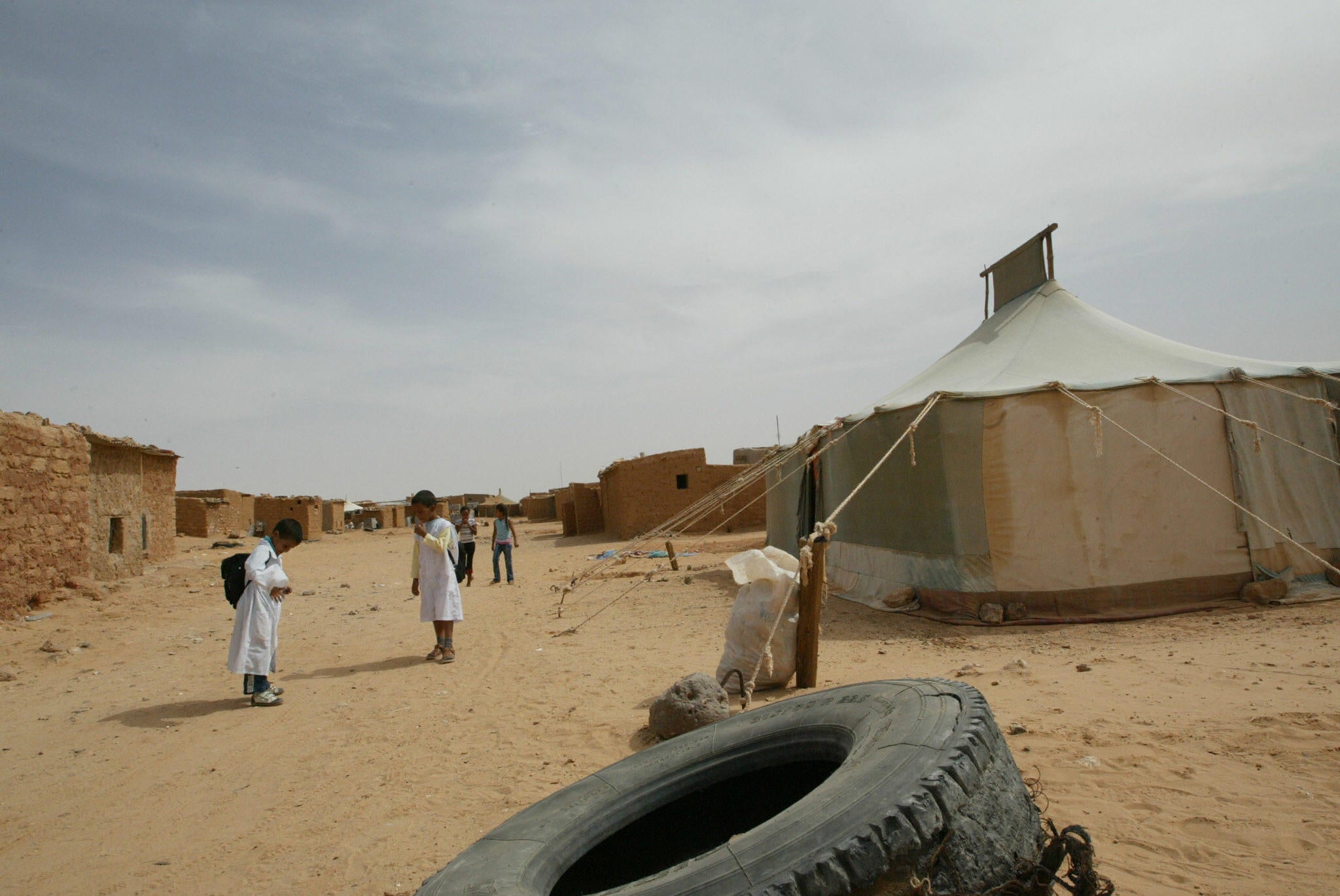
(Rabat, December 19, 2008) - Morocco violates the rights to expression, association, and assembly in Western Sahara, Human Rights Watch said in a new report issued today, revealing stark limits to the progress that Morocco has made in protecting human rights overall. Human rights conditions have also improved in the Sahrawi refugee camps managed by the Polisario Front in Algeria, although the Polisario marginalizes those who directly oppose its leadership.
Human Rights Watch called on both Morocco and Polisario to take specific steps to improve the human rights situation in the territories under their de facto control, and on the United Nations Security Council to ensure regular human rights monitoring in both Western Sahara and Tindouf.
"The repression has eased somewhat, and today dissidents are testing the red lines," said Sarah Leah Whitson, Middle East and North Africa director at Human Rights Watch. "But Moroccan authorities - to their credit - ask us to judge them not against their own past record, but against their international human rights engagements. By that standard, they have a long way to go."
The 216-page report, "Human Rights in Western Sahara and in the Tindouf Refugee Camps," focuses on the present-day situation rather than on past abuses. Human Rights Watch documents how Morocco uses a combination of repressive laws, police violence, and unfair trials to punish Sahrawis who advocate peacefully in favor of independence or full self-determination for the disputed Western Sahara.
"The Western Sahara is an international problem that has been on the back burner for decades," said Whitson. "But through this conflict, the world can also understand and address the broader human rights challenges that remain for Morocco."
In Western Sahara, Moroccan authorities consider all opposition to their rule of the disputed territory as illegal attacks on Morocco's "territorial integrity," and use this as a basis to ban or disperse peaceful demonstrations and to deny legal recognition to human rights organizations. The problem goes well beyond repressive laws, however: police beat peaceful pro-independence demonstrators and sometimes torture persons in their custody, Human Rights Watch said. Citizens file formal complaints about police abuse that the justice system routinely dismisses without conducting serious investigations, reinforcing a climate of impunity for the police.
While Sahrawi demonstrations sometimes involve acts of protester violence that Moroccan authorities have a responsibility to prevent and punish, this cannot justify blanket bans on peaceful assemblies. Moroccan courts have convicted Sahrawi human rights activists of inciting or participating in violence based on dubious evidence, in trials that were patently unfair.
In preparing this report, Human Rights Watch interviewed scores of people living in Western Sahara as well as present and former residents of the Tindouf refugee camps. Both Moroccan and Polisario authorities received the Human Rights Watch delegation, imposed no significant obstacles on its work, and provided extensive answers to questions from Human Rights Watch that are reflected in the report.
In the Tindouf refugee camps, the Polisario Front allows refugees to criticize its management of daily affairs, but effectively marginalizes those who directly oppose its leadership. Residents are able to leave the camps if they wish to, including to resettle in Moroccan-controlled Western Sahara. The fact that most take the main road to Mauritania rather than a clandestine route shows their confidence in being allowed to travel. Yet, those headed to Western Sahara tend to hide their plans, fearing both official obstacles and the disapproval of other camp residents if their final destination becomes known.
The population of the camps remains vulnerable to abuses due to the camps' isolated location, the lack of any regular independent human rights monitoring and reporting, and Algeria's claim that the Polisario, rather than Algeria itself, is responsible for protecting the human rights of the camps' residents.
"The refugees in Tindouf have, for more than 30 years, lived in exile from their homeland, governed by a liberation movement in an environment that is physically harsh and isolated," said Whitson. "Regardless of the current state of affairs, both the Polisario and the host country, Algeria, have responsibilities to ensure that the rights of these vulnerable refugees are protected."
Human Rights Watch said that the UN Security Council should ensure that the UN presence in the region includes regular human rights monitoring. Virtually all UN peacekeeping missions around the world include a human rights component and, with MINURSO forces operating in a peacekeeper capacity in Western Sahara, this region should be no exception. In this, France and the United States, as the permanent Security Council members with the strongest interests in this region, have a critical role to play.
Among its many recommendations, Human Rights Watch urges Morocco to:
- Revise or abolish laws that criminalize speech and political or associative activities deemed affronts to Morocco's "territorial integrity" and that are used to suppress nonviolent advocacy in favor of Sahrawi political rights;
- End impunity for police abuses by ensuring serious investigations into civilian complaints and, where warranted, charges or disciplinary measures against abusive agents;
- Allow independent human rights associations to follow the procedure for obtaining legal recognition; and
- Ensure that courts reach verdicts based on the impartial weighing of all relevant evidence. Judges and prosecutors should give effect to suspects' right under Moroccan law to demand medical examinations, and reject as evidence any statement that is established to have been made as a result of police torture.
Human Rights Watch urges the Polisario Front to:
- Take pro-active measures so that all camp residents know that they are free to leave the camps, including to settle in Moroccan-controlled Western Sahara;
- Ensure that camp residents are free to challenge peacefully the leadership of the Polisario Front and to advocate options for Western Sahara other than independence; and
- Eliminate or restrict broadly worded articles of the Polisario penal code that, for example, criminalize the printing of publications or participating in demonstrations deemed "likely to disturb the public order."
Morocco has ruled Western Sahara de facto since its troops moved in following Spain's withdrawal from its former colony in 1976. Morocco officially refers to the region as its "southern provinces," but the United Nations does not recognize Moroccan sovereignty.
Morocco opposed as unworkable a UN-brokered plan for a referendum on the territory's future and has proposed autonomy for the Sahara under Moroccan sovereignty. Morocco has made clear, however, that the plan envisages no rollback of laws criminalizing "attacks on territorial integrity." Thus, Moroccan-granted autonomy will not give Sahrawis their right to demand independence or a referendum to decide the region's future.
"Sahrawis differ on how to resolve the conflict," said Whitson. "But wherever they live, authorities must allow them peacefully to express and act on behalf of those views. Any proposed solution for the Western Sahara that does not guarantee these rights is no solution at all."
Human Rights Watch takes no position on the issue of independence for Western Sahara or on Morocco's proposal for regional autonomy.
Monday, December 15, 2008
Missionaries in Morocco
God Help Us.

Reuters Catholics pray in Saint Pierre Cathedral in Rabat, Morocco
A new breed of undercover Christian missionary is turning to Muslim North Africa in the search for new converts, alarming Islamic leaders who say they prey on the weak and threaten public order.
Missionary groups say the number of Moroccan Christians has grown to 1,500 from 100 in a decade and that Algerian Christians number several thousand, although no official figures exist.
They say their message is reaching thousands more, thanks partly to satellite TV and the internet.
The Koran states no-one can be forced to follow one religion, but many Muslims believe that to abandon Islam is to shun family, tribe and nation and bring shame upon relatives.
"Many Muslims told me 'If I find you I will kill you'," said Amin, a young man from northern Morocco who did not want to give his full name for fear of reprisals.
Amin said he became aware of Jesus Christ after dreaming that a figure dressed in a white robe approached him in a forest and handed him a Bible.
"When I told my father I had become a Christian he just stared at me without speaking. Then he said: 'From now on, you are not my son. Go to those people, let them feed you and give you a home - we'll see who cares for you'," said Amin.
He left town, stopped his studies and now lives from translation work offered by a Christian missionary group.
Mission groups in North Africa range from broad alliances such as Partners International and Co-operative Baptist Fellowship to small Baptist and Pentecostal churches based in the Americas and Europe, according to their websites.
Their activity is growing as churches turn their focus to places where the Christian message is rarely heard, said Dana Robert, world Christianity professor at Boston University.
"With the internet and the increase in travel, you have a democratisation of missions where anyone who feels like it can go anywhere they want," said Robert.
"The new breed of missionary doesn't have the same historical training as the older established denominations, nor necessarily the cultural training, so there's a bull-in-a-china-shop effect."
Persecution, exploitation
Converts recount stories of persecution as evidence of the risks they run.
These are impossible to verify, but one said he heard a newly converted Moroccan was thrown from a balcony in a shopping mall by two acquaintances, leaving him paralysed.
Another said people of a town in eastern Morocco threatened to decapitate a convert unless he renounced his faith.
Islamic leaders say missionaries exploit people with a weak understanding of their religion, target the poor and the sick and try to win over North Africa's Berbers by telling them Islam was imposed on them by Arabs.
"These are unethical methods," said Mohammed Yssef, general secretary of the Superior Council of Ulemas, Morocco's highest religious authority.
"Islam is the religion of God. It is neither Arab nor Berber.
"When people respond positively (to missionaries), it is when they don't have their full freedom," said Yssef.
"Once they recover their normal health and situation, they recover their ability to decide."
The missionaries deny exploiting the weak.
They say their clandestine status means they have to set up businesses or language schools at which converts are sometimes employed.
"Three years ago I began praying about parts of the world that had not taken up the Gospel," said Tyler, a member of an Ohio Baptist church who set up Project North Africa in Morocco.
He said that his work could be disrupted if he gave his surname.
"The goal is to give a clear presentation of the Gospel and address things people might have been told - for example that the Bible is corrupt or that we worship three gods."
He said he was preparing the ground for colleagues, mostly from South America, who would learn Morocco's dialect and seek to set up small businesses to fund the group's evangelical work.
The convert Amin said hundreds of Moroccan Christians gather every year in Sale near the capital Rabat to celebrate Christmas, protected by police.
But the meeting is an exception and indigenous Christians say they worship alone and in secret.
Failure
Christian communities existed in North Africa until Arabs arrived from the east from the eighth century, and most of the local population adopted Islam.
Attempts to re-Christianise the area were a failure that came to be symbolised by Frenchman Charles de Foucault, who tried to establish a Christian community in the Algerian desert.
His example of abject poverty failed to inspire the local Tuareg to convert, and Muslim insurgents shot him dead in 1916.
French settlers built striking churches in Casablanca, Rabat, Algiers and Tunis to symbolise their imperial civilising mission but congregations dispersed after independence.
Morocco's government says it practises religious tolerance but the Christian presence is low-key.
St. Peter's Cathedral in Rabat does not ring its bells and churchgoers are all foreign.
Moroccan Christians worshipping there would risk arrest and Archbishop Vincent Landel said he would not baptise a Moroccan convert as it is against the law.
He said US-funded missionaries had made life harder for the Roman Catholic Church in North Africa.
"It upsets everything because all these evangelical converts lack restraint and discretion - they do any old thing," he said.
"And to Muslims there's no difference between a Catholic, an evangelist or a Protestant, so in their minds the head of all the Christians must be the Catholic Archbishop."
One way to heaven
Outside the cities, the visible Christian presence is limited to small communities from Roman Catholic orders that lead charitable work including medical and wealth-creating projects, but avoid preaching.
They rely on smooth relations with the authorities, but in Algeria the climate has soured in recent months after a series of trials against local Protestants accused of proselytism.
The constitution of Algeria, the birthplace of St Augustine, a Berber, allows freedom of conscience but a 2006 law strictly regulates how religions can be practised and forbids attempts to convert Muslims.
"We shouldn't kill one another in the name of religion," Algerian Religious Affairs Minister Bouabdellah Ghlamallah told Liberte newspaper.
"That people come from the US and France to spread ideas contrary to national unity, that's the danger."
A Christian community that employs 70 women making embroidered Berber ceremonial clothes in Algeria's restive region of Kabylie works towards cohabitation among religions.
"We are in the service of beauty which is a quality of God, and that is also mentioned in the Koran," said Sister Elizabeth Herkommer, who runs the project.
Missionaries like Tyler take a more radical line.
"If there is just one way to heaven, it is my responsibility to show it," he said.
"If you had the cure to the AIDS virus, would you not want to take it to the people?"
Thursday, December 11, 2008
The Murchidat and Moroccan Islam - an NPR piece

A lot has been said and written about the Murchidat, and everyone has an opinion about them.
Here is another interesting piece to add to the conversation. It appeared today on NPR's The World, the link is right here, the summary is pasted below.
Morocco's King Mohammed VI has a new approach for countering Islamic extremism in his country. He's begun enlisting women to be religious guides who preach tolerance and the rejection of violence.