Translate

Showing posts with label Amazigh/Berber culture. Show all posts

Saturday, October 29, 2016

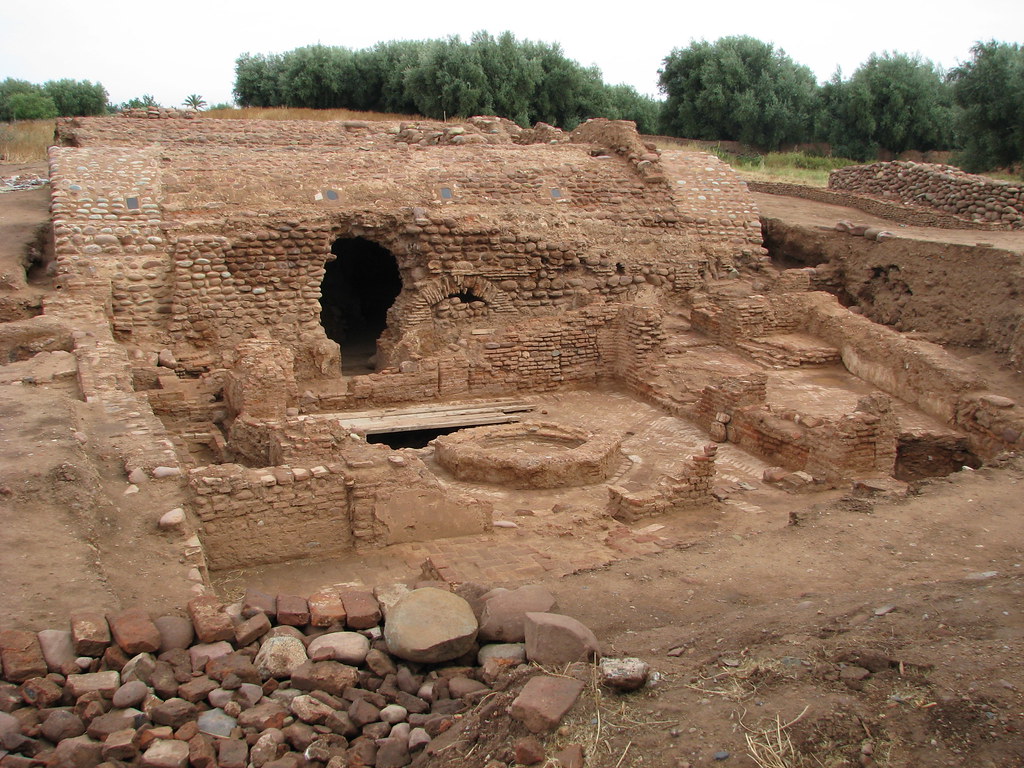
Archaeological Preservation in Aghmat - An important Location of Moroccan Medieval History

Here is a piece from the Archaeological Institute of America on a project they are supporting to restore parts of Aghmat, an important town in Moroccan history.  Another short musing about Aghmat in French from Zamane magazine can be found here.
_____________

 AIA and Hilton Worldwide Award Site Preservation Grant to Moroccan Site
 
Credit: https://www.flickr.com/photos/exchangesphotos/5854294730/
October 7, 2016

The Medieval site of Aghmat, located at the base of the High Atlas Mountains in the Ourika Valley, was the capital of the southern districts of Morocco and the center of Berber control of the region.

The city was a key location for commercial, political, and religious exchange in the Middle Ages and despite the relocation of the capital to Marrakech in the eleventh century by the conquering Almoravids, Aghmat carried on as an important religious center and as a strategic link between the Sahara and the rest of Morocco.

For over ten years, Ronald Messier, Professor Emeritus at Middle Tennessee State University and Director of the Moroccan-American Project at Aghmat has been excavating four of the most important monuments in the central part of the city: the hammam (public bath), grand mosque, the adjoining ablution hall, and the royal palace. The excavations have elucidated Aghmat’s historical trajectory from independent city-state, to imperial capital, to major commercial-religious center and its significance to the history and culture of Morocco and western Islam.
 FULL ARTICLE

Monday, September 22, 2014

The Moor's Account - a new book about a Moroccan explorer of the Americas

Lala Laila Lalami has penned a new piece of historical fiction. Her new book is entitled The Moor's Account and deals with the story of the life of a Moroccan Berber who visited America in the 1500s  (We've mentioned him earlier on this blog - see the tag "Esteban of Azemmour.")
Here is a link to her discussing the book on NPR.  And here is a New York Times article about the book.

Happy Reading!
_________________


His Manifest Destiny
‘The Moor’s Account,’ by Laila Lalami

By JEFFERY RENARD ALLEN SEPT. 5, 2014
credit: cmems.stanford.edu

In 1527, the Castilian conquistador Pánfilo de Narváez and a crew of 600 men sailed from Spain to the Gulf Coast of the United States to claim “La Florida” for the Spanish crown. Laila Lalami recounts the voyage — and its brutal aftermath — in her new novel, “The Moor’s Account,” from the perspective of Estebanico, a ­Moroccan slave of one of the explorers. It’s a fictional memoir, told in a controlled voice that feels at once historical and contemporary, that seeks to offer a truer account of the expedition than the official (and hopelessly biased) version of events provided by Álvar Núñez Cabeza de Vaca, one of the other three survivors.

It quickly becomes apparent that a strong moralistic impulse drives the story. Crossing “the Ocean of Fog and Darkness” and arriving in America, the conquistadors suffer biblical afflictions in the form of unbearable heat and hordes of mosquitoes. Disease does away with a good number of them, as do the Indians, who take the remaining men captive.

But Lalami is far more interested in what happens to the men after they escape and make their way from Florida to Mexico, bearing witness to wondrous terrain and tribal people. Here we see the previously untold history of the black man as explorer, and an explorer cut from a different cloth.

FULL ARTICLE 


Friday, September 28, 2012

The Plight of the People in Northern Morocco's Rif Region

Here is an interesting opinion piece/historical overview from Aljazeera English on the distressed situation facing the Rifians (riyafa)  in Morocco's most Northern Region.
____________
The plight of the Rif: Morocco's restive northern periphery:
The unrest in the Rif is based in the tumultuous history of Rifians as a battered people on Morocco's northern periphery

by Akbar Ahmed  with Harrison Akins
Last Modified: 28 Sep 2012 09:20
The Moroccan journalist, Hamid Naimi, has received a number of ominous and mysterious death threats in the last few weeks. Based out of the Spanish enclave of Melilla on the northern Moroccan coast, Naimi's blistering reports on the corruption of the Moroccan central government and its treatment of the Berber periphery have become a thorn in the side of the administration.
Naimi, originally from Morocco's northern region, the Rif, has been in exile since 2005, when his newspaper Kawaliss Rif  ("Stories from the Rif") was shut down by the government.

The travails of Naimi expose the challenge of Morocco in dealing effectively with its Berber periphery, particularly the Rifian Berbers in the north. The Arab Spring protests across the country have led to new constitutional reforms for the nation, yet more must be done to account for and alleviate the problems of the Rif and its Berber tribes who have felt neglected by the central government for decades.
Over the past year, protests in the Rif pointed to the issues which plague the region - high rates of poverty, unemployment, a media blockade and brutal tactics employed by the police to crush any unrest. To understand the current relationship between Morocco and its northern periphery, we must look into the history of the Rif with its Berber tribes and its interactions with the centre. 

Resisting encroachment
The largely unknown mountainous region of the Rif, meaning "the edge of cultivated land", in northern Morocco has struggled with central authority for the past century. The Rifian Berbers, ensconced in their mountains, have lived according to a code of honour, hospitality and revenge within their system of clans and kinship networks, allowing them to regulate justice and social order without the presence of state institutions for centuries. The Rifian Berbers, distinct from the Atlas Berbers in central Morocco, have their own Berber dialect, Tarifit. 


Sean Connery depicted the importance of dignity and honour among the Rifians with empathy in the 1975 film The Wind and the Lion. Connery, himself a Scotsman, played the Rifian tribal chief Mulai Ahmed el Raisuli with flair. The film recounts the historic events surrounding el Rasiuli's kidnapping of an American expatriate, Ion Perdicaris (portrayed in the film as a woman played by a glamorous Candice Bergen), and his son for a ransom and control of two government districts from the Moroccan Sultan. 

Connery's acting accurately displays el Raisuli's reputation of treating his hostages with respect and hospitality, even going so far as protecting them from harm. Perdicaris would later write of el Raisuli, "He is not a bandit, not a murderer, but a patriot forced into acts of brigandage to save his native soil and his people from the yoke of tyranny".  
The Rifians with their sense of honour and fierce independence resisted the encroachment of central authority. Beginning in the late 19th century, Spain made a number of military incursions into the Rif region, clashing with the Berber tribes. With the establishment of the Spanish Protectorate of Morocco in 1912 over the north of the country, the Spanish military attempted to bring the mountainous area under central rule. 

By 1921, Abd-el-Krim, a Rifian tribal leader, declared independence from Spain. Abd-el-Krim caught the attention of international media, appearing on the cover of TIME Magazine in August 1925. To defeat Abd-el-Krim and his allied tribes, Spain relied on overwhelming military force and the extensive use of early forms of air power and chemical weapons to subjugate the rebellious tribes.
King Alfonso XIII of Spain captured the mood of the country when he stated that the aerial gas campaign was for "the extermination, like that of malicious beasts, of the Beni Urriaguels [Abd-el-Krim's tribe] and the tribes who are closest to Abdel Karim". The resulting war which ended in 1926 proved devastating for both: the Spanish lost as many as 50,000 men and the Rifians had roughly 30,000 casualties. 
With the Rif's inclusion into independent Morocco in 1956, the Rifians felt sidelined with Arabs, who represented the dominant culture, and others from Francophone Morocco favoured for administrative posts within the newly centralised government. 

Violence erupted in the Rif in October 1958 when tribesmen attacked markets and local offices of the nationalist Istiqlal Party and, then, escaped into the mountains. Despite these attacks against the state, the Rifians were quick to express their traditional loyalty to King Mohammed V due to his holy lineage, separating his religious authority from his political authority. 
This has been how Berbers have viewed central authority throughout history. During lulls in battles between government forces and Berber tribes of the Atlas Mountains in the late 19th century, for example, Berber women would kiss the Sultan's cannons and ask them for benediction in order to defeat the Sultan's forces, as the cannons carried the Baraka, or blessing of the Sultan and thus the Prophet. 

'Cruel punishment'
In January 1958, the government responded to the Rifians' overtures of violence with 20,000 troops of the newly formed Forces Armees Royales (FAR), over two-thirds of the entire army, led by Crown Prince Hassan, to carry out what the King called a "cruel punishment". 

When the Crown Prince's plane was landing in the Rif Mountains, he was greeted by gunfire from Rifian sharpshooters hiding in the brush at the edge of the landing strip. The FAR responded by indiscriminately bombing entire villages and raping Rifian women. The uprising came to an end in the following month with casualties for the tribesmen exceeding 10,000.  

After King Hassan ascended the throne in 1961, the Rif remained largely neglected by the central government and as a result, suffered from some of the highest levels of poverty in the country. In the Rif in the 1960s, for example, the infant mortality rate within one week of birth was over 50 per cent. 
With very little development from the centre and lacking economic opportunities, its people were forced to resort to widespread hash cultivation and smuggling merely to survive. Many Rifians chose to settle in slums surrounding Casablanca and other major Moroccan cities or travelled to Europe as migrant labourers with the majority of Moroccan immigrants in Europe from the Rif. 

The bread riots in the Rif in the 1980s, sparked by rising food prices, were quickly suppressed by the government with King Hassan describing the Rifians in a nationally televised speech as "savages and thieves". 
The unrest in the Rif is based in their tumultuous history as a battered people on Morocco's northern periphery. Understanding their history, the people of the Rif need to be treated with compassion and sympathy. This presents not only a dilemma for dealing with the Rif, but also an opportunity. 

For the Moroccan centre, King Mohammed VI is almost unique in the Muslim world as a ruler with a holy lineage. The King, with the compassion and Baraka of the Prophet, should act to help these beleaguered people while respecting their culture and understanding their history.
The Rifians only want the rights and opportunities of full citizens of a modern and inclusive Morocco. Only then can peace and stability be brought to the troubled northern periphery of an important Muslim nation.

Thursday, May 19, 2011

Berber Odes : Poetry from Morocco's High Atlas Mountains


Here is a piece about a recently published compilation of Moroccan Berber poetry in translation. The article is geared towards travelers (aka tourists), but good books are for everyone.
______________________

Book Review: Berber Odes

by Heather Carreiro.

Part of Eland’s Poetry of Place collection,Berber Odes is a compilation of poetry in translation edited by Michael Peyron, visiting professor at Al Akhawayn University in Ifrane, Morocco.

From my year spent studying abroad at Al Akhwayn in 2003-2004, I still have vivid memories of professor Peyron’s 8:00 a.m. course, History and Culture of the Berbers. Since no textbooks were available, we used a heavy, photocopied reader that he’d compiled over the years. It was full of academic essays, poetry, proverbs, snippets on Berber dialects, black and white photos and historical accounts.

During class, Peyron would often deviate from the day’s lecture to give a quick pronunciation lesson, share the tale of a Berber saint or expound on a proverb. His excitement made clear that he loved learning about the Berber people and sharing their culture with others.

Berber Odes is the product of almost 20 years of Peyron’s work in Berber poetic genres. Morocco’s Berber population is spread throughout the country, with Tarifit-speaking Berbers in the northern Rif Mountains, Tamazight-speaking Berbers in the Middle Atlas and Tashelhit-speaking Berbers in the Souss region in southwest Morocco. While the book focuses on poetry from the Middle Atlas, Peyron’s primary area of research, it also includes a short selection of poetry from the Rif and a substantial selection of poetry from the Souss.

The original poems were either collected via audio recording by Peyron, accessed in the Berber archives stored in Aix-en-Province, collected and shared by Peyron’s colleagues and students or derived from other historical records.

The book is a thin, light, 4” by 6” volume that can easily fit into a purse, backpack or a coat pocket. Poems are organized by region, and the back of the book includes a bibliography for further reading and an index of the poems listed by both title and first line. Each poem is given in English translation, in verse form, and is followed by a paragraph of detailed contextual information from the editor.

The collection ranges from humorous ballads to didactic religious instructions and appeals to saints, although many of the poems focus on the themes of war and bravery. The breadth of these traditional odes and the context given for each one offers unique insight into Berber history and culture. As these poems have never been translated into English before, Berber Odes is an invaluable resource for scholars and travelers who wish to learn more about Morocco’s indigenous people.

The following excerpt demonstrates the tension felt among the Berbers, who traditionally have lived in Morocco’s highland areas, regarding urbanization, moral decline and trusting outsiders.

Excerpt from “Hospitality Betrayed” (pages 84-85)

To fresh matters must I now refer, indeed there’s much to say.
Our first night I spent passing as a guest in a friend’s house.
Sufficient was the meal, even though today, come what may,
Some men are reluctant to open their door to visitors.
It takes but little patience to spend the evening together,
Enough time for intentions, worthy and unworthy, to show.
Say what I must, these times are at once good and bad.
As to what fate holds in store, how should we know?
We lack nothing material, yet our minds are in turmoil! [...]

In peace do I wish to live, trusting in fellow Berbers,
Whereas in big cities, with mixed population, crime is rife,
Women, newborn babies, all are victims of misfortune!
For a handful of coins a man will slay his neighbor!
In these times, e’en the highlands are dangerous [...]
No safety in sleeping near a nomads’ encampment!
With thy name do I comment, O Lord, thou and
Thy eternal dwelling-place!


I would definitely recommend that anyone interested in Moroccan culture pick up a copy of Berber Odes. The contextual explanations are written with a general audience in mind; you don’t need to be a poet or a scholar to appreciate the wealth of cultural knowledge that can be gleaned from reading these odes and ballads.

What I like most about the book is its small size and easy navigability. Most of the poems are shorter pieces, and you don’t need a solid half an hour to digest one of them. Instead, you can pull it out of your pocket or backpack while waiting for a grand taxi, sitting at a cafe or taking a short break while hiking in the Middle Atlas and read one or two poems.

The book is easily portable and could make for an excellent discussion starter with English-speaking Moroccans you meet during your travels. The verses and information packed into its 125 pages represents decades of the editor, Michael Peyron’s, work among the Berber people, and the book contains information and cultural insight that you won’t be able to find published anywhere else.

If you plan on visiting Morocco or know someone else who is, Berber Odes would make an ideal travel companion. Reading it made me anxious to get back to the mountains of Morocco myself.

Monday, March 21, 2011

Bringing Si Abd El-Krim, the Rifi Warrior Home to Morocco


Here is a piece from Public Radio International' show the World on the valant man from the Rif who fought Spanish and French colonizers in Morocco, and attempts by his relatives to get his remains repatriated to Morocco from Egypt. If you clink on the link, you can access the audio.
_____________________________________
Abd El-Krim: A Moroccan Hero who Never Was
By The World ⋅ March 17, 2011

By Gerry Hadden

As North African and Arab citizens cast about for leaders to fill the political vacuums in their countries, a quick remembrance of one such leader from days gone by. Abd El-Krim made his name liberating northern Morocco from Spanish colonial rule, in 1921. He was a scholar, a warrior and, for a brief time, even an emir. But Abd El-Krim was also a Rif, an ethnic group within the region’s larger Berber community. And that’s kept him sidelined in Morocco’s official history.

It began with the decisive battle against the Spanish, in 1921, at Annual, in the
mountainous Rif region of northern Morocco. The fight pitted Abd El-Krim and his rag-tag Rif militias against thousands of Spanish troops. One former Rif fighter, an elderly man named Chaaib Si-Mohand N’aali ,spoke of their victory in a Spanish documentary three years ago.

“Abd El-krim was our leader,” the old man recalled. “We surrounded the Spanish. They resisted. But they were afraid and exhausted. We wiped them out.

The Rif are ethnic Berbers … the indigenous people who’ve lived in North Africa for more than two millennia. The story of how their leader, Abd El-Krim, liberated them from colonial exploitation has become a legend for them. Journalist Merieme Addou’s grandfather fought alongside Abd El-Krim. Addou said Abd El- Krim was far outnumbered by the Spanish and knew he couldn’t fight an ordinary war.

“You need to have a tactic to win,” she said. “The Rif is a region of mountains. As foreigners, if you come here you don’t know this place. You don’t know where you are. So it was kind of using this very hard, difficult land, using it as a way to defeat the Spanish; using guerilla fighting.
Declaring independence

After victory, Abd El-Krim established the Rif Republic, a state independent not only from Spain and Morocco’s other colonizer, France, but from Morocco itself. The Republic’s new emir sent letters to every European head of state to announce it.

But his declaration fell on deaf ears. Five years of fighting later, the combined Spanish, French and Moroccan armies drove Abd El-Krim into exile, in Egypt. He died there in 1962 without ever setting foot back in Morocco. Not even after it gained full independence from France in 1956.

The Rif rose up once more, in 1958, and were brutally put down by then King Mohammed V. The repression continued under the next king, Hassan II according to Samed Assid, a Berber activist.

“Hassan II had a policy of vengeance,” Assid said. “He punished the Rif. Like Ghaddafi is doing now to his own people, in Libya. Hassan massacred the Rif population. And we have never forgotten. And we have not integrated. Today we are still a separate population.”

As for Abd El-Krim, Assid said the Moroccan government has simply fabricated his role in history.

“His story has been falsified in our schoolbooks,” he said. “Open a Moroccan textbook today. It says that Abd El-Krim fought against the French and Spanish …for the Moroccan throne. The books don’t mention his project to set up an independent Rif
republic. That is taboo.”

Assid said the taboo started in 1921, the moment Abd El-Krim declared his Rif Republic. The Moroccan state, dominated by Arabs, never wanted to mention the subject again.
Disappearing taboos

But 90 years later, some taboos surrounding the Berber have disappeared.
Assid, who is now president of the Morocco’s Royal Institute of Berber – or Amazigh – Culture, demonstrated on a recent day, sitting in his office. He sang a traditional Berber poem. In his hands he held a book with the lyrics, written in the Berber alphabet.

“Our current King, Mohammed VI, created this Institute,” he said. The king has also allowed our language back in public schools. And he’s allowed it to be written down, in its own alphabet. Before 2001 this was forbidden. If someone wrote in Berber letters on a sign or hotel awning, for example, he would be jailed.”

But one Berber wish remains unfulfilled; Abd El-Krim remains buried in Egypt. And there’s no indication that the government will let his relatives bring his remains home. But the pressure is mounting, said journalist Merieme Addou. She said that during Morocco’s largest pro-democracy march this February, some Rif carried Abd El-krim’s photo, and signs asking for his repatriation.

“I think there is no real reconciliation with the Rif people until his body is back and buried in his home town,” she said.

Moroccan Berbers are also talking about forming their own political party. If they do, and democratic elections are held, the Rif may just be able to vote their legendary hero home.

Tuesday, December 14, 2010

Morocco Liberalizes Policy on Giving Children Amazigh (Berber) Names


Here is a piece from Human Right Watch by way of ReliefWeb. Since April the Moroccan government has allowed people to give their children Amazigh names that are "Moroccan in nature." They have an interesting way of defining this if you read through the piece.
_____________________________________

Morocco/Western Sahara: More Freedom to Name Their Children


Source: Human Rights Watch (HRW)

Date: 14 Dec 2010

State Recognizing More Amazigh, or Berber Names, but Choice Still Restricted

(New York, December 14, 2010) – A government directive liberalizing Morocco's policy on recognizing Amazigh, or Berber, given names for newborns is having positive results, Human Rights Watch said today.

In April 2010, the Ministry of Interior issued a directive that for the first time defined Amazigh names as meeting the legal prerequisite of being "Moroccan in nature." In the eight months since, there have been fewer complaints from citizens that local bureaus of the Civil Registry have refused to register Amazigh given names, several Amazigh rights activists told Human Rights Watch. However, the general requirement that parents choose names that are deemed "Moroccan in nature" continues to limit parents' choices and create administrative obstacles and should be eased, Human Rights Watch said.

"By explicitly recognizing Amazigh names as Moroccan, the government has eased a noxious restriction on the right of parents to choose their children's names," said Sarah Leah Whitson, Middle East and North Africa director at Human Rights Watch. "This move shows greater respect and recognition for Morocco's ethnically and culturally diverse population."

Some members of Morocco's Amazigh population have in recent years grown increasingly assertive in demanding official recognition of their culture and Tamazight language. The Moroccan state responded by creating a Royal Institute of Amazigh Culture in 2001 and initiating elementary school instruction and programs on state television in Tamazight.

However, the Civil Registry's refusal to register many newborns whose parents had given them Amazigh first names remained a sore point for Amazigh activists. This was all the more true since the ostensible grounds for the rejection was that these names were not "Moroccan," in contrast to accepted Arab-Islamic names, even though the Amazigh are indigenous to the country while Arabs migrated to it centuries ago.

While the directive (circulaire in French, daouriya in Arabic) reaffirms that the Civil Registry may accept only names that are "Moroccan in character," it instructs clerks of the agency to "guide, convince, dialogue and show flexibility toward the citizenry," and, "before refusing a name, research and investigate and take into consideration the decisions by the High Commission of the Civil Registry and the courts."

The High Commission, consisting of the kingdom's official historian and representatives of the Justice and Interior Ministries, rules on the legality of those first names that the Civil Registry has refused or hesitated to accept. For example, a list of names issued by the Commission shows that in its meeting on June 24, 2005, the Amazigh name "Sifaw" was among those it rejected and the Amazigh name "Mira" among those it accepted.

The April 2010 Directive

The Interior Ministry sent its Directive D-3220, dated April 9, to regional, provincial, local, and district governments, all of which house branches of the Civil Registry, where citizens register births, deaths, and marriages.

Directive D-3220 interprets the law that governs the choice and registration of first names, Law 37-99 on the Civil Registry, adopted on October 3, 2002. Article 21 of that law requires that a given name have "a Moroccan character and must be neither a name of a family nor a name composed of more than two first names, nor the name of a city, village or tribe, and must not constitute an affront to good morals or the public order."

Directive D-3220 refers to "the right of citizens in choosing names for their children" and the need to prevent violations of that right and to "avert conflicts that might occur between clerks at the Civil Registry and citizens."

The directive elaborates on the procedures that the Civil Registry should follow when confronted with an unfamiliar name. It also makes public for the first time a two-part official definition of "Moroccan" as it relates to given names. The first part of the definition says:

Moroccan in character means the characteristics of the Moroccan society, from its north to its south and from its west to its east. The personal name has to be in use in Morocco to the point where it has become frequent; that is, to the point where holding that name has entered into custom, so the name sounds foreign neither to the Moroccan ear nor to the Moroccan milieu, with all its constituent parts. It is, thus, a name that is widespread, to the point that there is no discomfort or difficulty in recognizing it.

The second part says that given names must also come from one of the following five categories:

(1) Arab names that have been used in Morocco for a long time;

(2) "Attributes of Allah" (asmaa' Allah al-husna), as long as they are preceded by "'Abd" [meaning "servant of"] and not just by "el-" [for example, 'Abd el-Karim but not el-Karim];

(3) Amazigh names, whose meaning might vary from one region to another;

(4) Names that have become common in recent years in Morocco and whose pronunciation in Arabic is clear and origins are Islamic; and

(5) Hebrew names for Moroccan Jews.

The directive also refers to existing lists of first names, many of them Amazigh in origin, that the High Commission of the Civil Registry had approved or rejected prior to the promulgation of Law 37-99. The directive states that civil registries may consult those lists, with their "approved" and "refused" names, but that these determinations are not legally binding.

Continuing Administrative Resistance: Case Studies

There are no publicly available statistics on the frequency with which Moroccan authorities have prevented parents from registering the given name of their choice. However, anecdotal evidence collected from Amazigh rights activists in Morocco suggests that administrative obstacles to the recording of Amazigh names were more frequent prior to the issuance of directive D-3220. But even before the Ministry of Interior issued the directive, Civil Registry bureaus accepted some Amazigh names, either right away or after the parents campaigned against or appealed their initial rejection.

Human Rights Watch documented the rejection of Amazigh names in a letter sent to the Interior Ministry on June 16, 2009, to which the government did not reply.

The stakes surrounding the registration of a name are not limited to personal or cultural expression. When the Civil Registry refuses to register an infant because of an objection to his or her given name, that infant is without legal status. The parents may face obstacles in getting public services, such as when applying for a passport for the child or seeking reimbursement for medical costs from state insurance plans. To avoid such problems as well as conflicts with the administration, some parents register an Arab-Islamic name rather than the Amazigh name they would otherwise choose, several Amazigh activists told Human Rights Watch.

While Directive D-3220 includes Amazigh names among those that may be considered "Moroccan in character" and instructs Civil Registry personnel to interact constructively with parents, the directive maintains a number of restrictions on the right of Moroccans to choose names for their children. They still face rejection if the clerk at the local Civil Registry bureau is unfamiliar with the Amazigh name they have chosen, or considers it difficult to pronounce or insufficiently familiar. This has occurred, for example, when a name is uncommon in one region but more popular in others.

Administrators at the local level continue to challenge some Amazigh names, as shown by a number of recent cases described to Human Rights Watch. While parents who persist seem to succeed in most cases, the procedure remains stressful and burdensome for families who, to exercise the basic right of naming their child, find themselves called upon to collect and submit additional documentation, make extra visits to the administration, enlist the support of nongovernmental organizations, or initiate a court case or media campaign.

Examples of names that were refused:

• Yuba (Agadir): On October 21, 2010, Mohamed Elouihyoui and his wife, Rouqiya Bogarn, tried to register the name "Yuba" for their son, born October 9, at the Civil Registry in the el-Houda neighborhood of the southern city of Agadir. Elouihyoui said that the clerk on duty refused on the grounds that it was not a permitted name. Elouihyoui returned more than once during the 30-day period for registering a newborn. Although he invoked Directive D-3220 and explained that Yuba is the name of an ancient Amazigh king, the clerk persisted in refusing to register the baby under that name. The parents have initiated the judicial procedure necessary to register a newborn's name once the 30-day period has passed. As of December 8, Yuba remains unregistered, his father told Human Rights Watch.

• Simane (Sidi Slimane): Aziza Boulwiha, from the city of Sidi Slimane, northeast of Rabat, gave birth to a girl on November 12, 2010. Three days later, her husband, Marzou Salh, visited the Civil Registry in the city's first arrondissement to inquire if he could register a newborn under the Amazigh name Simane, which means "two souls." The clerk said no since Simane did not appear on a list he had consulted, Salh told Human Rights Watch. The father said he then submitted Directive D-3220 along with documents showing earlier cases where Simane had been approved. On November 22, his wife went to register the name, but the Civil Registry again refused, explaining that Simane was not a sufficiently common name. The clerk proposed instead the name "Imane" – faith in Arabic – but the parents refused. Salh enlisted an Amazigh organization to contact the administration. In late November, according to Salh, the Civil Registry agreed to register Simane but also had him sign a statement that he assumed all the legal consequences of choosing this name.

• Mazilia (Lille, France): The Moroccan consulate in Lille, northern France, refused in July 2010 to allow a Moroccan émigré, Lhoussain Azergui of Roubaix, and his wife, Abda al-Kasri, a French citizen, to register the name "Mazilia Tara" for their daugher who was born December 10, 2009. Shortly after the baby's birth Azergui had registered her at the French civil registry. The official at the Moroccan consulate accepted "Tara," an Amazigh name that the same consulate had first rejected in 2006 but later accepted after Tara's parents produced the Moroccan registration document of another girl named "Tara." However, the official told Azergui that "Mazilia" was shown as a name that was "refused" on a list he had consulted.

Mazilia is one of 11 names marked as "refused" from a list of 40 given names that the High Committee on the Civil Registry ruled on during a session on July 5, 2006. That list is among those that the Interior Ministry circulated to Civil Registry bureaus.

Azergui told Human Rights Watch that he wrote a letter of protest to Moroccan authorities but has not heard back, and has not tried again to register his daughter. Azergui and al-Kasri had a similar problem when they tried to register their older daughter, Numidia Tin-Ass, on March 6, 2007, at the consulate in Lille. The clerk on duty, after consulting a list in Azergui's presence, accepted "Numidia" but not "Tin-Ass," promising to accept the latter if Azergui could produce the birth certificate of another Moroccan girl with this name. In December of that year, Azergui and his wife received a letter from the Moroccan consulate inviting him to register their daughter under the full name they had chosen.

Mazilia is the name of a dynasty of an ancient Amazigh kingdom.

• Simane (Kenitra): Rafii Seddiq of Kenitra, a city northeast of Rabat, went to a local bureau of the Civil Registry two weeks after the birth of his daughter on April 4, 2010. The clerk on duty refused the name and advised Seddiq and his wife, Hind Jabari, to choose a more common name. Seddiq told Human Rights Watch that Simane is more common in the Sousse region in southern Morocco than in the northern region, where he currently resides. Later the same day, Seddiq returned to the Civil Registry, brandishing a copy of Directive D-3220, and explained the meaning of "Simane." This time, the clerk registered the name.

• Massilya (Témara): One week after the birth of his daughter on November 3, 2010, Jamal Eddarhor went to the civil registry in Témara, a Rabat suburb, to register her as "Massilya," the name chosen by him and his wife, Samira Heri. This ancient and uncommon Amazigh name means "goddess of the sea." The clerk on duty responded that he did not know whether the name was acceptable and asked the parents to choose another. When Eddarhor refused, the clerk asked him to check with the préfecture of Temara to see whether the name could be registered. The préfecture said they could not respond but proposed that he submit his request in writing to the Civil Registry. The parents complied and received a favorable reply three days later. They registered their daughter's name on November 29.

International Law Supports Parents' Right

The purpose of requiring a "Moroccan character," Directive D-3220 states, is "to preserve our Moroccan identity, our authenticity, and our traditions that are founded on a firm basis."

But such an objective does not an constitute an adequate justification for infringing on the freedom of parents to name their children as they choose, Human Rights Watch said, noting that many of the names that are challenged constitute an expression of the parents' ethnic or cultural identity.

The internationally recognized rights to individual and cultural expression, as well as the right to privacy, and the duty of states to respect the rights of minorities, limit the power of the state to refuse names to exceptional and narrowly defined circumstances.

In the 1994 case of Coeriel et al v Netherlands, the United Nations Human Rights Committee ruled:

Article 17 [of the International Covenant on Civil and Political Rights (ICCPR)] provides, inter alia, that no one shall be subjected to arbitrary or unlawful interference with his privacy, family, home, or correspondence. The Committee considers that the notion of privacy refers to the sphere of a person's life in which he or she can freely express his or her identity.... [This] includes the protection against arbitrary or unlawful interference with the right to choose and change one's own name. [emphasis added].

A 2010 ruling by the same Committee in Raihman v Latvia stated that the imposition of a "Latvian-sounding name" on a member of the Russian Jewish minority in that country was a violation of the Covenant. Moreover, the ICCPR's article 27 states, "In those States in which ethnic, religious or linguistic minorities exist, persons belonging to such minorities shall not be denied the right, in community with other members of the group, to enjoy their own culture..." This right under article 27 extends to the freedom of choice when naming one's own children with minority names.

"Morocco should reform its law to limit strictly the government's role in the name-regulating business," Whitson said. "Unless a first name is patently offensive or objectionable or harmful to the interests of the child, authorities have no business curbing the right of parents to make this very personal choice."
Monday, November 15, 2010

Eid Al Adha in A Moroccan Berber Village

In keeping with the times, here is an article on Eid al Adha (3id elKbir) in a Moroccan Village. The article from the Huffington Post is from last year's celebration but worth a read.There are also some nice photos we have embedded in this post.
Eid Mubarak! عواشر مبروكة
____________________________

Sacrificial Sheep: Eid Al Adha In A Moroccan Berber Village

By Aida Alami
Moroccan Freelance Writer.
Posted: November 29, 2009 03:22 PM

Eid Al Adha Slideshow 1 from aida alami on Vimeo.


This past Saturday, we decided to spend Eid Al Adha, the Muslim holiday where people sacrifice a sheep, in the country side. We visited a little Berber village a few miles south of Marrakesh.

This is a tradition that has existed for centuries and Muslims all over the world celebrate it once a year. According to the Muslim history, the tradition started when God asked the prophet Ibrahim (Abraham) to prove his full dedication by sacrificing his only son: Ismael. It was extremely hard for Ibrahim to make a choice but he ultimately decided to show his loyalty to God and to kill his son. After he did so, God spoke to him and revealed to him that he instead had a sheep killed and that his son Ismael was alive because the willingness to sacrifice his son was enough of a proof of commitment .

Since then, Muslims commemorate this miracle by killing a sheep. Some of it is given to poor people but most families get together to celebrate and eat.

In Azimime, the village that we picked to spend the holiday, the mood was pretty festive. We arrived there at around 9:30 a.m. Women had woken early to make a delicious breakfast and to start preparing for the day. People were moving around the village, walking into their neighbors' houses to wish them a happy holiday. We received a very warm welcome from the villagers who rarely had outsiders visit them. Omar and his family invited us into their home, made us tea and after we were done, took us around the village so we could see people slaughtering their sheep, following the Muslim tradition.

Everyone was welcoming, offered us tea and wanted us to spend the night. In each home, a butcher came in to help with the slaughtering. Once it was done, the sheep was cut into pieces and every part was used to cook. First, we ate the liver, but did not get a chance to eat the head and other parts because they were going to cook on the fire the entire night.

We tried, in our pictures, to capture the tradition. The following slide-show takes us through a day with the villagers and their families on this holy day.

Monday, November 30, 2009

Eid Al Kbir in a Berber Village

This article is nice because it gives an intimate description of the Eid that just passed in a rural Berber village in Morocco.

__________________________________

Celebrating Eid Al-Adha in a traditional Berber village


Eid Al Adha from aida alami on Vimeo.


Aida Alami lives in Casablanca and writes for Le Journal Hebdomadaire, a French-language Moroccan magazine. She describes celebrations during the Eid Al-Adha holiday that concludes the hajj.

Two days after Americans feasted on turkey, Moroccans chowed down on lamb.

This weekend was one of the most important celebrations for Muslim people around the globe. For centuries, people annually sacrifice a sheep to follow a hallowed tradition. In Morocco, even people who cannot afford to buy meat most of the year save up to be able to buy a sheep.

This tradition is based on making some sort of sacrifice to show God a full commitment. The legend says that God had asked the prophet Ibrahim, known as Abraham in English-speaking Judeo-Christian culture, to prove his full dedication by sacrificing his only son: Ismael.

Even if it was the hardest decision he had ever made, according to the tradition, Ibrahim ultimately decided to show his loyalty to God and kill his son. After he thought he had done so, God spoke to him and revealed that instead, he killed a sheep and saved the son. Muslims use this story to illustrate willingness to make a great sacrifice to show allegiance to God.

Since then, Muslims commemorate what they see as a miracle by sacrificing a sheep at the same time every year.

In the Berber village of Azimime, located in the south of Morocco almost 40 miles from Marrakesh, a family celebrated Eid Al-Adha in a typical festive way. Like every other year, the women wake up first, around 6 a.m., to make special foods for breakfast.


Kids and adults put on nice clothes bought for the occasion. Neighbors walk around the village to wish each other a happy holiday and stop for a cup of tea. After the men slaughter the sheep, the women start cooking all its parts. The first meal is a barbecue with all kinds of meat: liver, heart and so on. The families get together to celebrate and eat. The Eid celebration sometimes last three days — until all the meat is eaten.

Friday, September 4, 2009

Reading and Writing Berber in Morocco


Here is an article from the BBC about the Berber language in higher education in Morocco. I have a few problems with the premise of the article(as usual). I am not so quick to draw a line between Berbers and Arabs when so much of Moroccan history has been about the mixture of these two " identities," and also because i feel as if secular and Christian missionary motives (which both tend to be Islamophobic) like sticking their finger in this cultural and religious "rift."

___________________________________________


Trail-blazing for Morocco's Berber speakers


Aischa Bardoun

By Sylvia Smith
BBC News, Agadir

Aischa Bardoun sees herself as a trail-blazer. She is one of the first Moroccans to get a masters degree in the Amazigh language, spoken by the country's Berber majority.

"We are very excited," she says.

"We studied the older texts that were passed down orally, but we are also writing new literature to reflect the current situation for Berbers in Morocco. It's really ground-breaking."

Although Berbers were Morocco's first inhabitants and account for some 60% of Morocco's population, they faced widespread discrimination and it is only now that the language is required to be taught in public school.


Some students feel having a degree in the language will help get a job. Unfortunately that is not necessarily the case
Ahmed Sabir
University of Ibn Zohr

Their academic qualifications may not help them much on the jobs market, but the availability of a further degree in a subject that was once virtually outlawed in their North African country underscores Berber success in gaining official acceptance of the language.

As well as the University of Ibn Zohr offering degrees in Amazigh, an umbrella term for the three dialects of Berber that are spoken in Morocco, the previously oral-only language has moved further into the mainstream with the creation of a Royal Institute of Amazigh language and culture.

Illiterate

Ms Bardoun and her classmates are all big fans of the doyenne of Moroccan Amazigh singers Raissa Talbensirt.


In her late 50s, Ms Talbensirt speaks only Tashelheit, the local dialect, but was a huge hit at the annual Berber festival, Timitar, attended by tens of thousands of young people.

She can neither read nor write but composes traditional music with local musicians.

"I am glad that the music is being carried forward by the new generation," she says.

"They listen on iPods and watch video clips on their computers, but it all helps our cause."

New alphabet

Although many Amazigh are illiterate, the government has put in place measures to assist schools to teach the written form of the language.

The Royal Institute of Amazigh has overseen the creation of an alphabet based partly on the mystical signs and symbols of the Tuareg found inscribed on tombs and monuments.


This written form is expected to have a unifying effect.

It is essentially a new form of the language which, it is hoped, all Moroccan Berbers will speak and understand.

It has also raised unrealistic hopes according to Ahmed Sabir, Dean of the Faculty of Arts at the University of Ibn Zohr.

"We were very oversubscribed when we started accepting applications for our Amazigh courses," he explains.

"Some students feel having a degree in the language will help get a job. Unfortunately that is not necessarily the case."

Fears of extremism

But while many Berbers, until recently excluded from jobs in education and government, make up Morocco's underclass, there are also the super-rich who have made fortunes in business.

Many live in the commercial capital, Casablanca, and in the past funded Berber activist groups.


According to Gerd Becker, a German cultural consultant living just outside Agadir, the main reason for the recent change of heart over Berber status stems from the government's desire to provide an alternative model to the radical Wahabi form of Islam.

"There was a danger of the country being taken over by fundamentalism," he says.

"The Amazigh culture offers a ready-made, more liberal identity that many Moroccans already identify with."

Although most Berbers are Muslim, some are Jewish or even Christian and with Amazigh stretching across northern Africa from Egypt, Tunisia, Algeria, Niger and Mali to Morocco, it is language that holds the rather disparate elements together.

And while Arabic remains the official language of the country, when it comes to music, young Moroccans either listen to Western music, or to rap in Amazigh.

Foreign language

Fatman, lead singer with the Agdir-based hip-hop band rap2bled says that the Berber language is being used to pass on messages about drug use and unemployment.
map

"My parents couldn't read a newspaper or understand the television because they were in Arabic," he says.

"Now we have our own television channel and magazines in Berber. We feel much closer now to people in the Rif and Atlas Mountains."

But for intellectuals and activists, this is just the beginning.

Abullah Aourik, an artist and publisher of a magazine in Amazigh, wants to see Berber replace Arabic as the official language of the country.

"We think it would be appropriate to change part of our constitution so that Arabic is no longer required for legal documents or for any official communication," he insists.

"Most Moroccans grow up speaking Berber - why should they be at a disadvantage in having to use classical Arabic which is a foreign language whenever they brush up against bureaucracy?"

The government may not be ready yet to entertain this idea which seems far-fetched to even the majority of the Amazigh themselves, but the teaching of Amazigh in public schools and at university level could in the future lead to it being recognised as a national language - as it already is in Algeria, Mali and Niger.